Look a little closer
See the mechanism
The paper loads a small spring
Read the diagram
Paper inserted between the clip’s clamping portions displaces the spring wire. The wire presses back on both faces of the stack. Contact friction opposes sliding along those faces, while the spring shape maintains the normal pressure.
Original spring-wire principle, not the exact offset geometry of the historic patent or an inventor claim for every Gem clip. The lower inset enlarges deflection at a different scale. Coral arrows are normal contact action; the navy arrow is attempted paper sliding. No force or capacity value is encoded.
Diagram basis: US1298542A: spring wire and opposite clamping portions; OpenStax: friction between contacting surfaces.
Sources: Benjamin L. Mink; United States patent publication via Google Patents · OpenStax, Rice University
The loops make opposing contacts
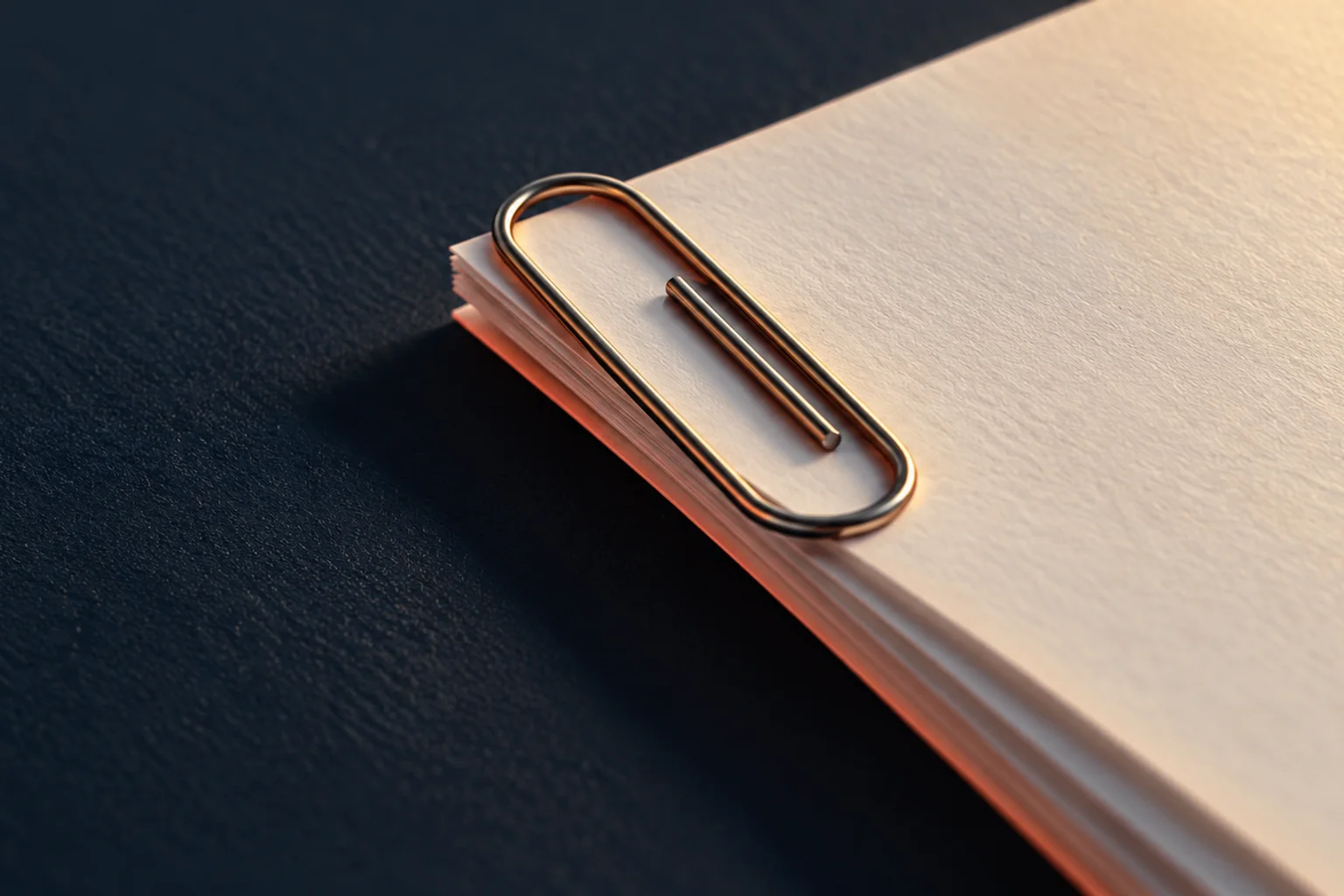
Follow a double-loop wire clip around the paper's edge. Parts of the wire lie on opposite sides of the stack, connected by bends that pass around the edge. Inserting the paper separates those contacts from their unloaded arrangement.
US1298542A describes a spring-wire clip with opposing clamping members joined by a loop. Its particular offset form is a design example. The principle isn't a tiny hinge hidden in the bend: the wire itself yields as the sheets enter.
Sources: Benjamin L. Mink; United States patent publication via Google Patents
Pressure gives sliding something to work against
The elastic response presses the wire onto the outer sheets. That pressure also brings neighboring sheets into contact. OpenStax's friction explanation describes how contact pressure helps surfaces resist relative sliding. Here, spring-loaded wire supplies that pressure to the stack.
Friction resists relative sliding along a contact; it isn't glue that bonds the sheets permanently. The clip can therefore hold while remaining removable. Its wire shape supplies the pressure, and the paper contacts help turn that pressure into resistance to slipping.
Sources: OpenStax, Rice University
Bending farther can change the clip itself
The explanation assumes the clip still has a useful elastic response around the stack. Forcing a wire far from its original shape can leave it with a different resting shape. A clip that no longer presses its opposing parts together in the same way has changed its clamping geometry.
Different wire profiles, coatings and loop arrangements change how the clip presses on the stack. The size of the loop alone doesn't tell you the holding force.
Sources: Benjamin L. Mink; United States patent publication via Google Patents · OpenStax, Rice University
The thing to remember
Paper deforms the wire; the wire presses back. Friction helps that spring pressure keep the sheets from sliding apart.
What this example leaves out
This explains the elastic double-loop wire-clip principle, not an exact history or blueprint of every Gem-style clip. Contact positions and permanent bending depend on the clip and stack; no sheet-count rating is implied.
Sources & further reading
Source access dates are listed below. Manufacturer descriptions and patents support the specific constructions described, not every product.
- Paper-clip — US1298542A ↗
Benjamin L. Mink; United States patent publication via Google Patents · Retrieved 2026-10-16 · Spring-wire opposing clamping members connected by loop; elastic yielding when applied, changed geometry after excessive distortion.
Description on common planar clip and proposed offset form read. No Gem invention history, author identity claim or exact modern clip shape inferred; drawing functional. - 5.1 Friction — College Physics2e ↗
OpenStax, Rice University · Retrieved 2026-10-16 · Friction opposes relative/attempted sliding at contact; normal pressure and material affect resistance.
Actual definitions and introductory pressure/friction discussion read. General contact principle synthesized with spring-wire patent; no paper friction coefficient or measured clip force. UVA indexed snippet informed search but full page unavailable and not used as sole proof.