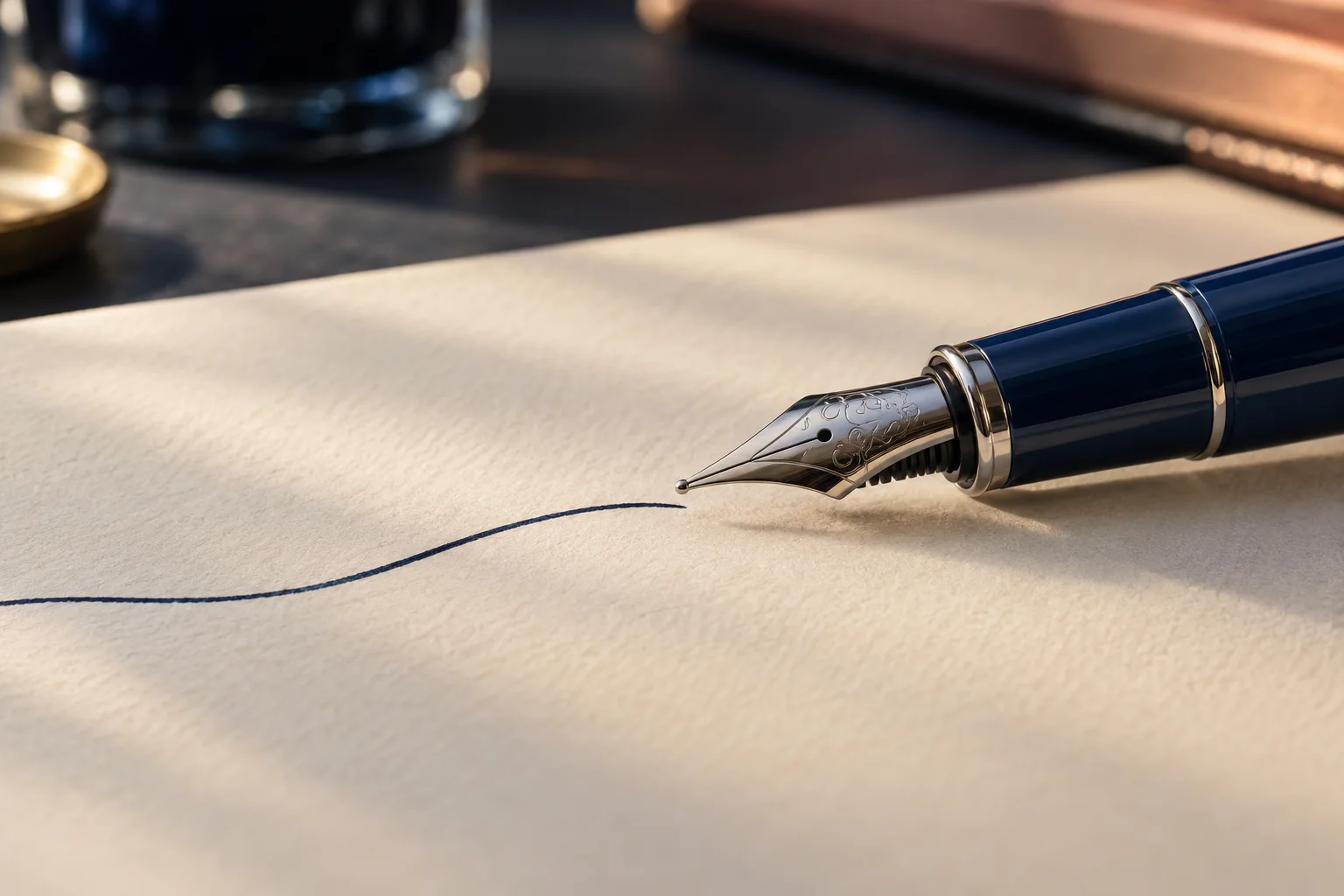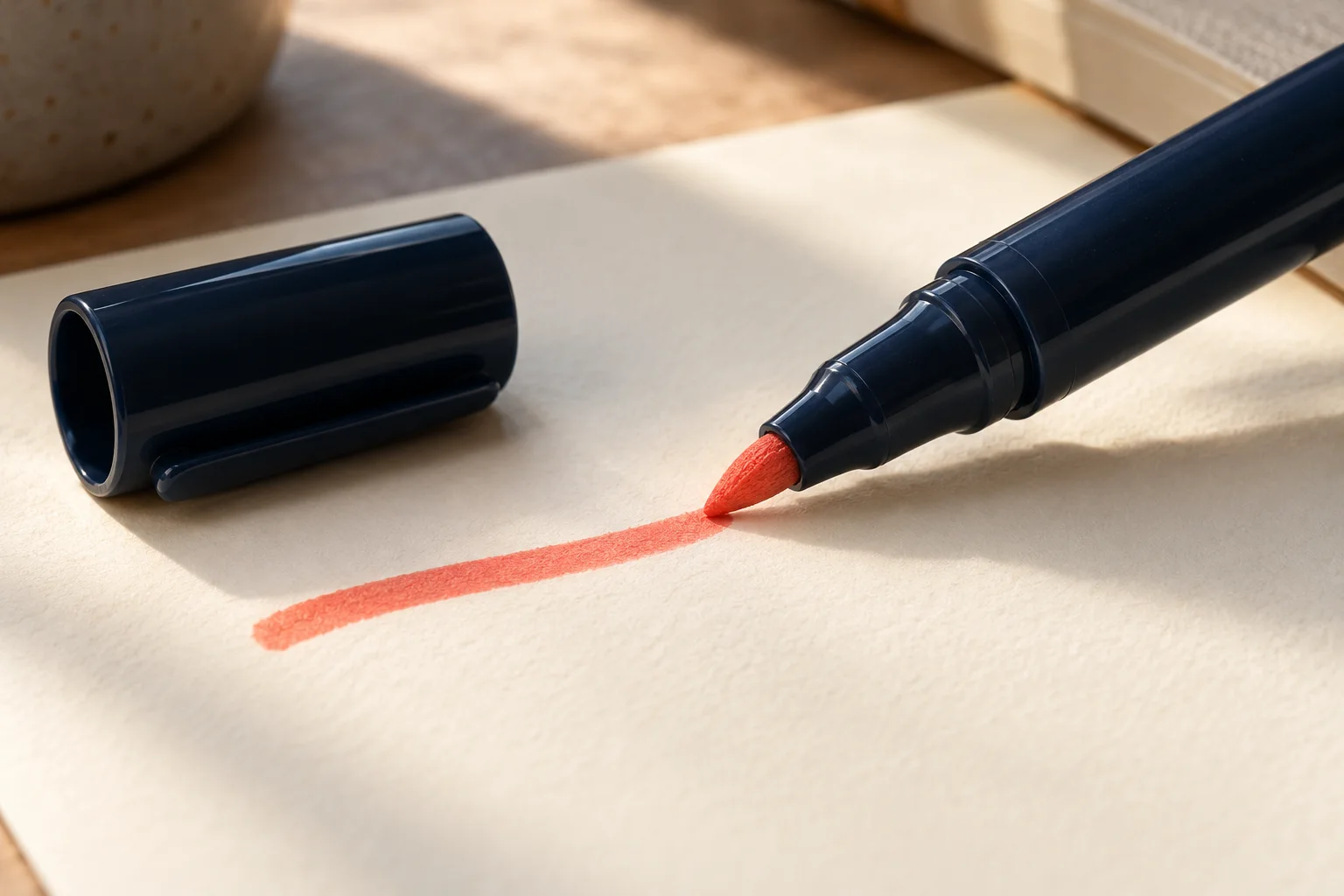
Look a little closer
See the mechanism
A connected ink path
Read the diagram steps
Wet tip feeds the page. Ink passes through the porous reservoir and nib to the paper. A separate airway lets the barrel equalize pressure.
Exposed tip dries. Solvent leaves the exposed end. A dry terminal region interrupts the useful liquid path even if ink remains in the reservoir.
Conceptual single ink path; vent layouts and reservoir designs vary. Arrows are routes, not measured flow rates.
Diagram basis: Marker reservoir, nib and airway description.
Sources: Terence William Bolton / European Patent Office via Google Patents · edding
The tip is part of a continuous wet path
Inside a reservoir-fed marker, absorbent material holds ink rather than leaving it as a freely sloshing pool. The inner end of the nib touches this material, connecting the stored liquid to the writing surface.
A nib can be made from fibers or another porous material. The useful feature is its network of small passages: liquid wets their walls and forms curved surfaces that support capillary flow.
Sources: Terence William Bolton / European Patent Office via Google Patents · edding
Ink leaving needs room for air
Liquid cannot keep leaving a rigid sealed barrel indefinitely without changing the pressure inside. Marker designs therefore provide a route for pressure equalization. One documented design leaves an airway between the reservoir sheath and the outer casing.
That air route serves a different purpose from the ink-filled pores. The nib brings liquid to the page; the vent prevents a growing pressure difference from opposing the supply.
Sources: Terence William Bolton / European Patent Office via Google Patents · edding
A cap protects the exposed end
The wet tip also exposes ink to air. Solvent loss can dry that small working region and stop flow even when some ink remains farther inside. The cap slows drying between uses.
Sources: Terence William Bolton / European Patent Office via Google Patents · edding
The thing to remember
The nib works because its tiny liquid paths remain connected to a larger ink supply.
What this example leaves out
This describes a porous-reservoir marker. Pump-fed paint markers and free-ink designs can use additional valves or regulators, and vent layouts vary.
Sources & further reading
Source access dates are listed below. Manufacturer descriptions and patents support the specific constructions described, not every product.
- EP1358075B1 — Marker pens ↗
Terence William Bolton / European Patent Office via Google Patents · Retrieved 2026-10-18 · Absorbent reservoir, porous nib, capillary supply and pressure-equalization airway.
Read description: background and Figure 1 parts 8,9,13–16; web lines 138–142,199–207. Patent is an example with two nibs; article abstracts one porous ink path, not that special dual-nib mechanism or market adoption. - How can I prevent my edding markers from drying out? ↗
edding · Retrieved 2026-10-18 · Unclosed marker nib can dry out and stop ink flow.
Read complete short FAQ. Manufacturer product guidance, not a diagnosis of every faint marker.