Look a little closer
See the mechanism
A turning surface carries the ink
Read the diagram
Ink crosses on the ball. Paper contact turns the ball as the pen travels right. The ball surface carries ink from the reservoir side through the socket to the paper. The ball turns; the socket travels with the pen.
Original enlarged section, not a manufactured socket profile. Ink film and clearance are exaggerated; the figure does not model ink feed in every orientation.
Diagram basis: PILOT: ball rotation transfers ink.
Sources: PILOT Corporation · TOMBOW PENCIL
One surface moves between ink and paper
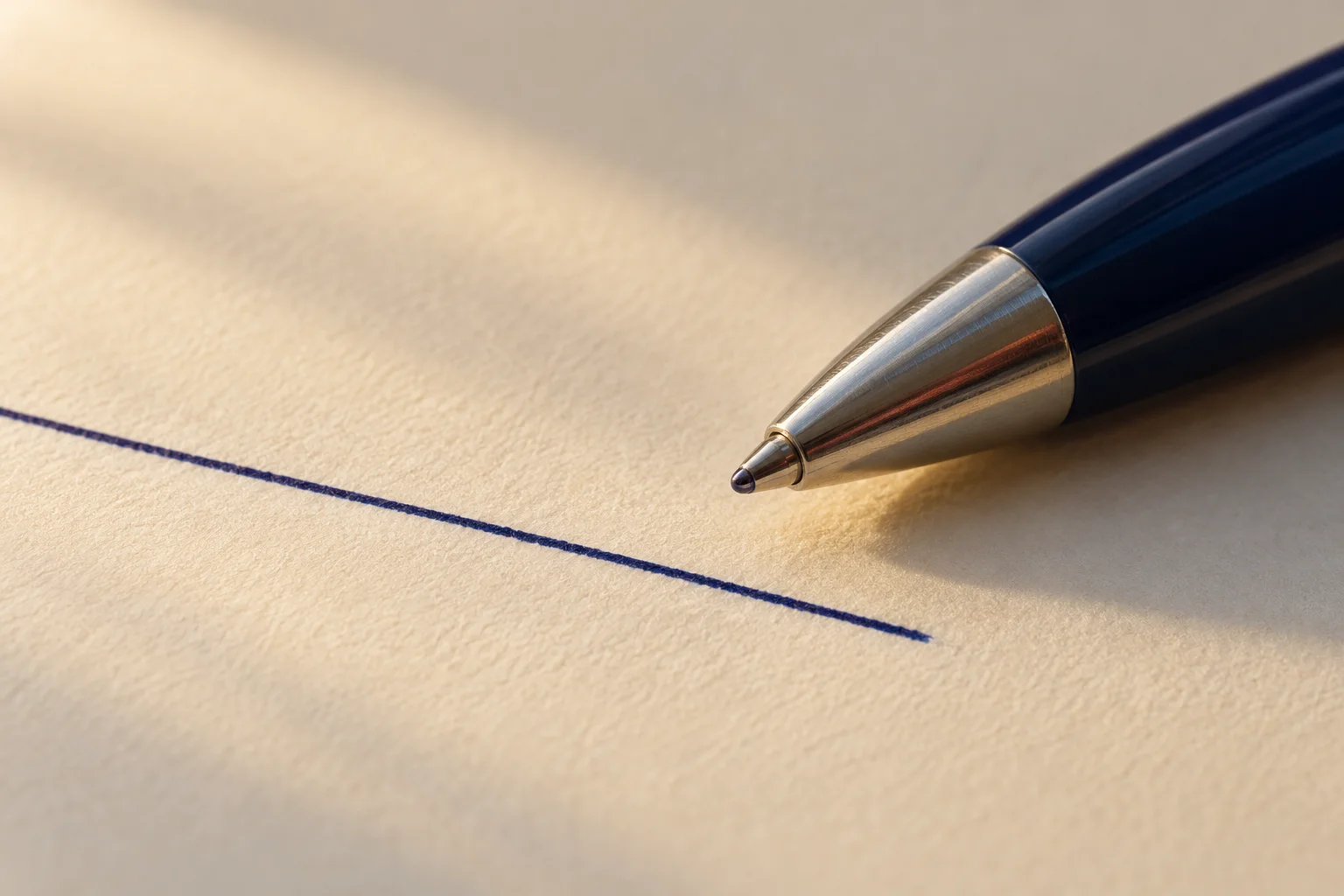
Move the pen across a page and the ball turns in its seat. A patch of its surface that was inside the tip reaches the paper, delivers ink, then returns inward. Pilot describes this rotating transfer as the basic writing action.
Sources: PILOT Corporation
The ink has to suit the tip
The turning ball needs a supply of ink, but the liquid's behavior matters too. Tombow distinguishes relatively viscous oil-based ballpoint ink from more fluid water-based ink. Those differences affect flow and the resulting writing; a ball alone doesn't make every ink behave the same way.
Wetting and rotation describe separate steps. Ink first adheres to the ball inside the tip. Turning then brings that coating outward. Without ink reaching and wetting that surface, motion cannot leave a continuous ink line.
Sources: TOMBOW PENCIL · PILOT Corporation
The click does another job
A click pen's latch extends and parks the refill. It can present a perfectly working ballpoint tip, but it doesn't turn the ball or put ink on the paper. The writing mechanism begins at the contact between tip and page.
Sources: PILOT Corporation
The thing to remember
The ink-coated ball rotates in its seat while the rest of the tip travels with your hand.
What this example leaves out
This describes a conventional liquid-ink ballpoint tip. Ink formulations and feed systems vary; it is not a claim that every pen writes at every angle. Pilot advises against writing with its tip directed above horizontal.
Sources & further reading
Source access dates are listed below. Manufacturer descriptions and patents support the specific constructions described, not every product.
- 一般的なボールペンの仕組みを教えてください。 ↗
PILOT Corporation · Retrieved 2026-10-17 · Ball rotation caused by movement against paper; ink adhering inside tip transfers to paper; above-horizontal warning.
Manufacturer explanation of a typical ballpoint. No universal angle capability or exact clearance inferred. - The Difference between water-based ink and oil-based ink ↗
TOMBOW PENCIL · Retrieved 2026-10-17 · Water-based versus oil-based ink and viscosity distinction.
Manufacturer stationery explanation; not a universal formulation or performance comparison.