Look a little closer
See the mechanism
The spring drives; restricted oil flow slows
Read the diagram
Controlled return. Opening the door loads the spring through the linkage. On closing, the spring drives the piston back. Oil displaced by the piston must pass through a restricted hydraulic path, which resists rapid movement. The restriction controls speed while the spring supplies the closing action.
Functional spring/piston/oil schematic, not an engineering layout. Actual closer channels, check valves and sweep/latch circuits vary. The line above represents the restricted return route rather than a literal external pipe.
Diagram basis: Norton General Information Guide, pp. 9–10.
Sources: Norton / Yale Security Inc., ASSA ABLOY · Allegion
Your push compresses the spring
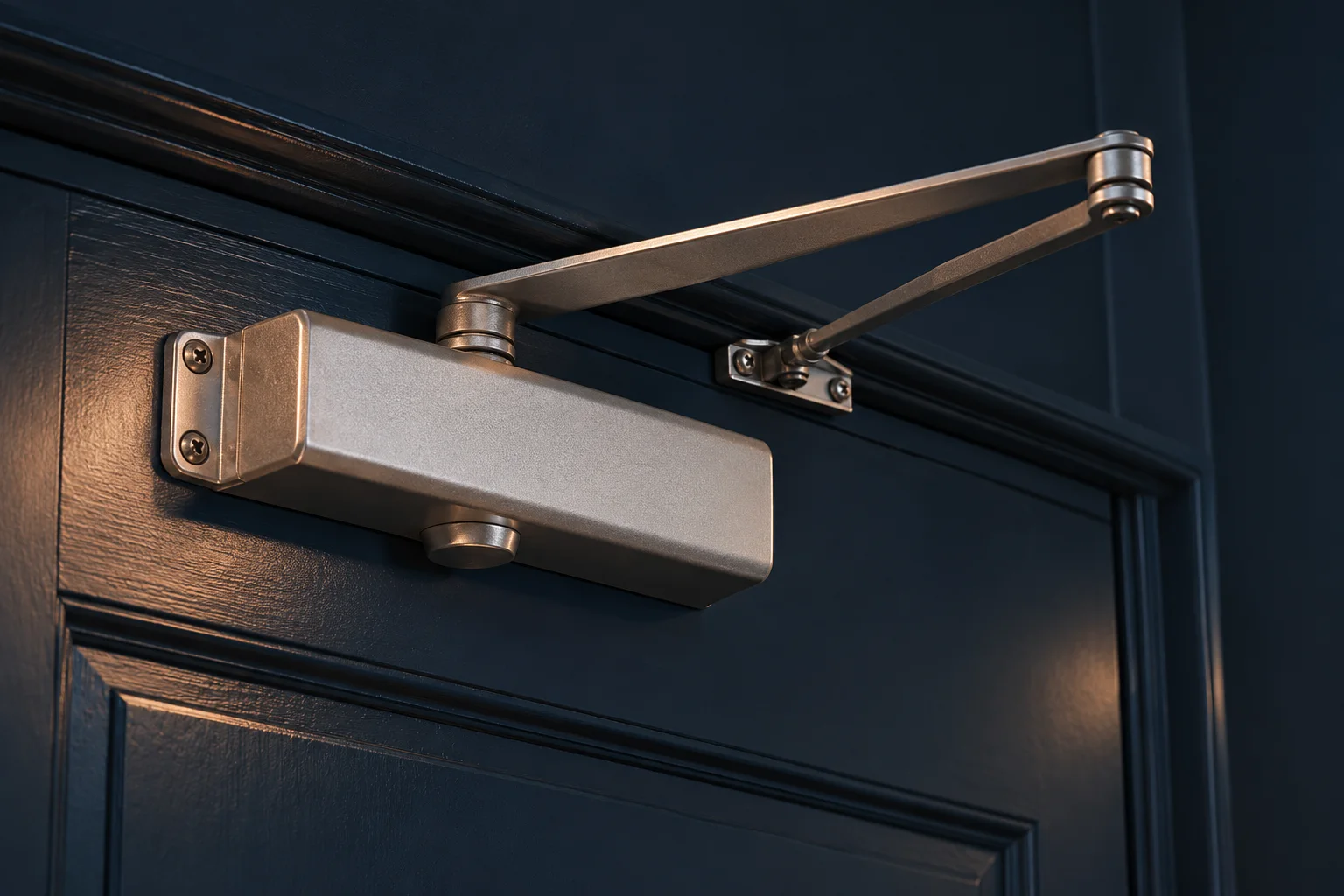
The two arms above the door connect the moving door to the frame. In a rack-and-pinion closer, their movement turns a shaft called the pinion. Its gear teeth engage a straight rack cut into a piston, converting rotation into movement along the housing.
That piston compresses a spring. Opening the door therefore puts energy into the closer; the spring can return that energy after your hand lets go. The fluid inside the housing also moves as the piston displaces it.
The piston cannot return without moving fluid
On closing, the spring pushes the piston toward its starting position and turns the linkage back. The moving piston displaces fluid, which must flow through the closer's regulated passage. Restrict that flow and the piston returns more slowly.
Closing force and closing speed are consequently separate adjustments. Spring force supplies the push; a hydraulic regulation valve changes how easily fluid can pass. Opening a speed passage farther does not give the spring more stored energy.
Sources: Norton / Yale Security Inc., ASSA ABLOY · Allegion
The final movement can have its own passage
Many closers control the main closing sweep separately from the last movement toward the latch. Norton's example routes fluid through a sweep passage during most of the return. Near closing, a collar on the piston blocks that route, leaving the latch-speed passage to control the remaining movement.
The door latch still has to enter its strike plate. The closer supplies the door's movement; the latch catches it at the frame. A change of pace near the frame can therefore be deliberate, rather than a spring suddenly becoming stronger.
Sources: Norton / Yale Security Inc., ASSA ABLOY · Allegion
The thing to remember
Follow the fluid path to understand the pace of the return; follow the spring and linkage to understand where the closing push comes from.
What this example leaves out
This describes a hydraulic rack-and-pinion closer. Cam-action, pneumatic and powered door operators differ. Closing ranges and settings depend on the product; this is not installation or fire-door adjustment guidance.
Sources & further reading
Source access dates are listed below. Manufacturer descriptions and patents support the specific constructions described, not every product.
- Door Closer General Information Guide ↗
Norton / Yale Security Inc., ASSA ABLOY · Retrieved 2026-10-17 · Rack-and-pinion piston, spring compression on opening, hydraulic flow control and separate sweep/latch passages.
Manufacturer document hosted by distributor; PDF pages 9–10 (zero-based pages 8–9), How a Door Closer Works and door controls. Generic drawing, not every closer. - Fluid for door closer ↗
Allegion · Retrieved 2026-10-17 · Regulation valves vary hydraulic flow and speed through closing phases.
Manufacturer FAQ list; only visible resolution text used; no repair guidance inferred.