Look a little closer
See the mechanism
The handles open it; the body holds it
Read every step
- Squeeze to open. With the handles raised, squeezing their ends together levers the free jaw ends apart. The continuous spring-steel body bends; the opening is not produced by a separate hinge between rigid jaws.
- Release and fold. The body springs back against the paper. Its elastic restoring force maintains the grip. Folding the handles away changes access to the levers, but does not remove the spring body that clamps the paper.
Original side-section model, not to scale. Only one wire outline per handle is shown. The spring body changes shape between states; no separate jaw hinge is implied. Arrows show motion or restoring action, not measured force or paper capacity.
Diagram basis: WO2014016568A1: description of a conventional binder clip.
Sources: WIPO patent publication via Google Patents · United States patent publication via Google Patents
The black shell is a spring
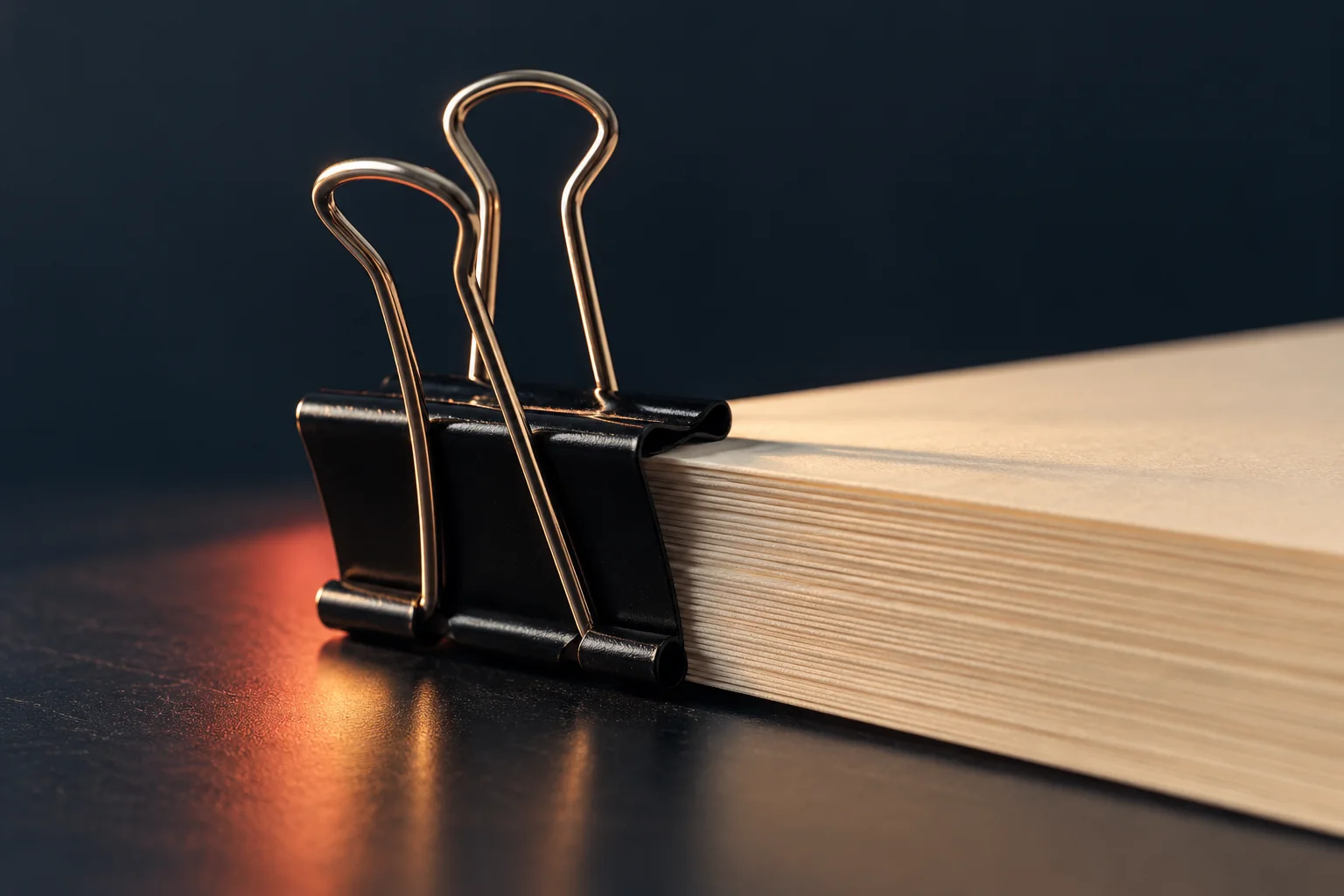
The familiar clip has two jaws joined by a broad back. Their free edges meet at the mouth. That body can flex: opening the mouth deforms the spring steel, which develops a restoring force toward its closed shape.
Patent WO2014016568A1 describes the conventional mechanism before proposing a different handle arrangement. It locates the flexing in the jaws, their connections and the transverse back. There isn't necessarily a separate little coil spring hidden inside the black shell. The shell itself does that work.
Squeezing one end spreads the other
Raise both wire handles over the clip's body and squeeze their long ends together. Their contact with the body turns that hand movement into separation at the jaw edges. The handles make opening the stiff mouth manageable without asking your fingertips to pull directly on those edges.
Release your squeeze with paper between the jaws. The steel tries to return, but the stack keeps the mouth slightly open. The continuing restoring force presses on the paper. The body stays flexed around the stack after the handles stop moving.
Sources: WIPO patent publication via Google Patents · United States patent publication via Google Patents
Fold the handles down; the grip remains
Once the stack is clamped, the wire loops can pivot away from their opening position. They no longer need to be squeezed for the steel to keep pressing. The visible change in handle position leaves the loaded spring body in place.
This gives the clip a different hold from a staple driven through paper: no bent staple legs are anchoring it on the far side. Its grip depends on the spring body remaining deformed around the stack. How much paper a particular size can hold is a separate product limit, not something the two wire loops reveal.
Sources: WIPO patent publication via Google Patents · United States patent publication via Google Patents
The thing to remember
The handles make the mouth open. Bent spring steel keeps it pressing closed after your hand lets go.
What this example leaves out
This explains the conventional one-piece spring-steel clip with pivoting wire handles. Other clip shapes use other springs and linkages. Jaw travel, grip force and stack capacity depend on the product.
Sources & further reading
Source access dates are listed below. Manufacturer descriptions and patents support the specific constructions described, not every product.
- Binder clip — WO2014016568A1 ↗
WIPO patent publication via Google Patents · Retrieved 2026-10-16 · Conventional spring-steel clip: connected jaws, pivoting handles, squeezing raised handles opens jaw ends against restoring force from body flexion.
Description of a typical/conventional clip, paragraphs228–232 read. Proposed label-friendly handle geometry not generalized. No force, life, sheet-count or historical claims. - Hole-punched binder clip — US9199506B2 ↗
United States patent publication via Google Patents · Retrieved 2026-10-16 · Spring-leaf action in clip body and jaw regions; pinching handles opens jaws and releasing closes them.
Description paragraphs268–269 read. This is a modified hole-punched clip; only spring/body function is used as corroboration, not its novel geometry or universal strength.