Look a little closer
See the mechanism
The striker hits; the dome vibrates
Read the diagram steps
Lever drives strikers. The thumb lever drives a gear train and rotating carrier with loosely mounted strikers. A striker briefly contacts the dome.
After the impact. After contact the striker clears the dome. The elastic metal continues vibrating, moving the air and producing a fading ring.
Geared internal-striker principle described in US20220355880; resonating dome/damping in US6450115. No magnetic mount, inverted cover, measured frequency or audibility claim.
Diagram basis: US20220355880 conventional-bell comparison.
Sources: USPTO / Google Patents · USPTO / Google Patents
A short thumb movement can produce several strikes
Inside one familiar type, the lever drives gears linked to loosely mounted metal strikers. Gear rotation carries them around the bell's interior, where they hit the dome. The lever supplies energy; the gear train changes the speed and travel of the striking parts.
That is one mechanism, not the definition of every bicycle bell. Another design bends or rotates a spring-mounted striker and releases it for a single impact. A similar external dome can therefore hide a different way of delivering the blow.
Sources: USPTO / Google Patents · USPTO / Google Patents
The ringing part is the dome
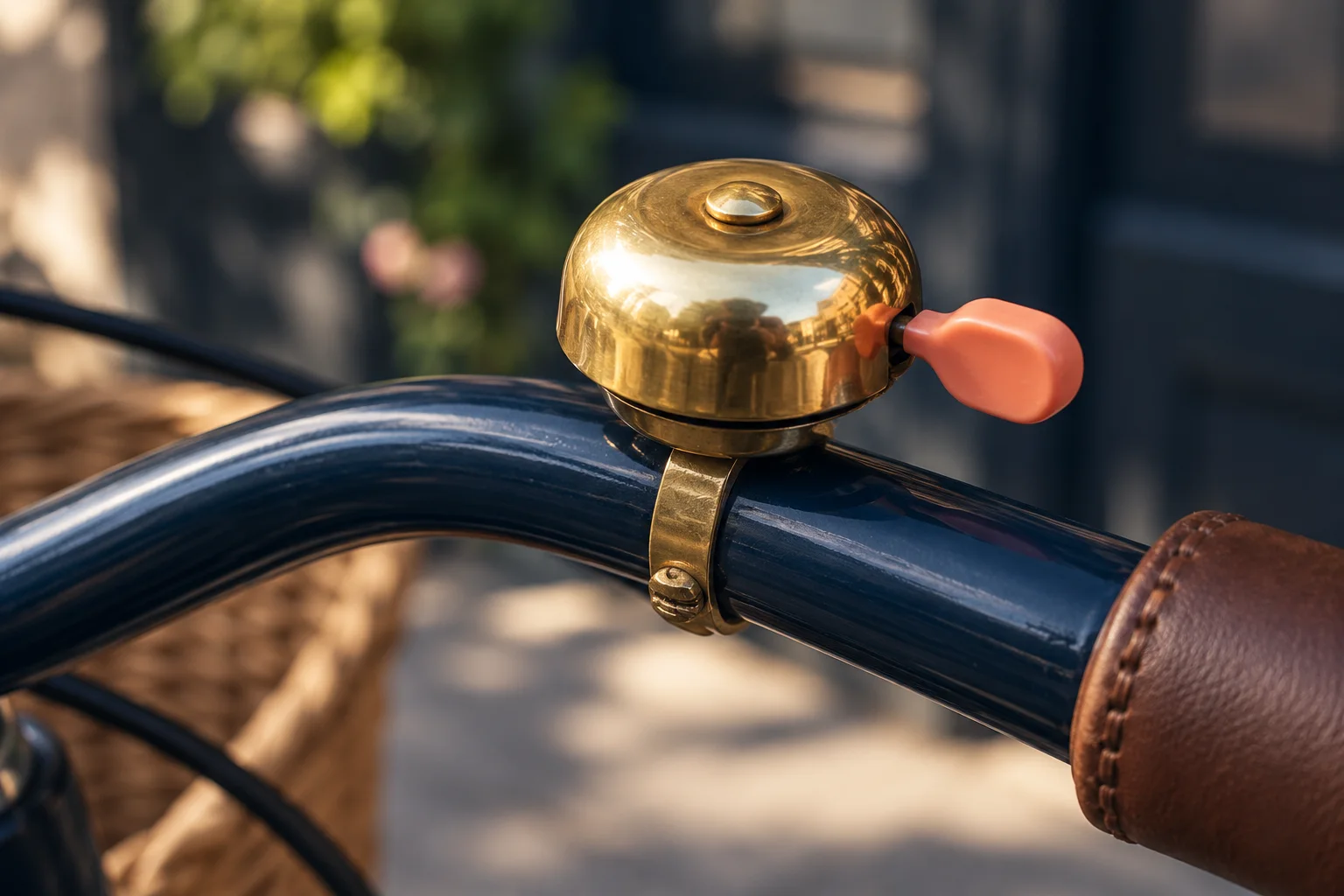
The striker's impact briefly deforms the dome. The metal's elasticity pulls it back, and its inertia carries it through repeated small movements. Those vibrations push and pull the surrounding air. The dome can continue sounding after the thumb has stopped moving.
The mounting supports the dome without holding every part of its surface still. Its shape, material and support influence how it vibrates. A bell is thus more than a hard surface struck by another hard part: its structure is the resonator.
Sources: USPTO / Google Patents
Contact can take energy out of the vibration
The ring fades as vibration energy leaves through sound and other losses. Extra contact can add damping. The inverted-dome patent discusses water drops on a small bell as one source of reduced vibration and a shorter chime.
A striker that hits and moves away delivers an impulse while leaving the dome free to respond. Holding a part against the dome changes that response by providing another path for energy to leave.
Sources: USPTO / Google Patents
The thing to remember
The mechanism delivers impacts; the dome converts those impacts into continuing vibration and sound.
What this example leaves out
The internal geared example is described in a patent background, not a claim about all bells. The inverted-dome source supports resonance and damping but its special cover is not part of the conventional bell diagram. No audibility or road-safety claim is made.
Sources & further reading
Source access dates are listed below. Manufacturer descriptions and patents support the specific constructions described, not every product.
- US20220355880A1 — Bicycle bell ↗
USPTO / Google Patents · Retrieved 2026-10-18 · Detailed Description opening web179–181: spring external clapper versus conventional geared thumb lever rotating loose metal discs inside dome.
Actual HTML read. Uses conventional comparator, not magnetic mounting invention. - US6450115B1 — Bicycle bell with inverted dome ↗
USPTO / Google Patents · Retrieved 2026-10-18 · BACKGROUND/Definitions: dome resonates, traditional single support, water-drop damping, striker types and lever/gear variation.
Actual search-returned description sections read. Resonance/damping only; inverted dome/cover is not ascribed to conventional bell. Qualitative elastic vibration account is physical analysis.