
Look a little closer
See the mechanism
The outer treatment and barrier have different roles
Read the diagram
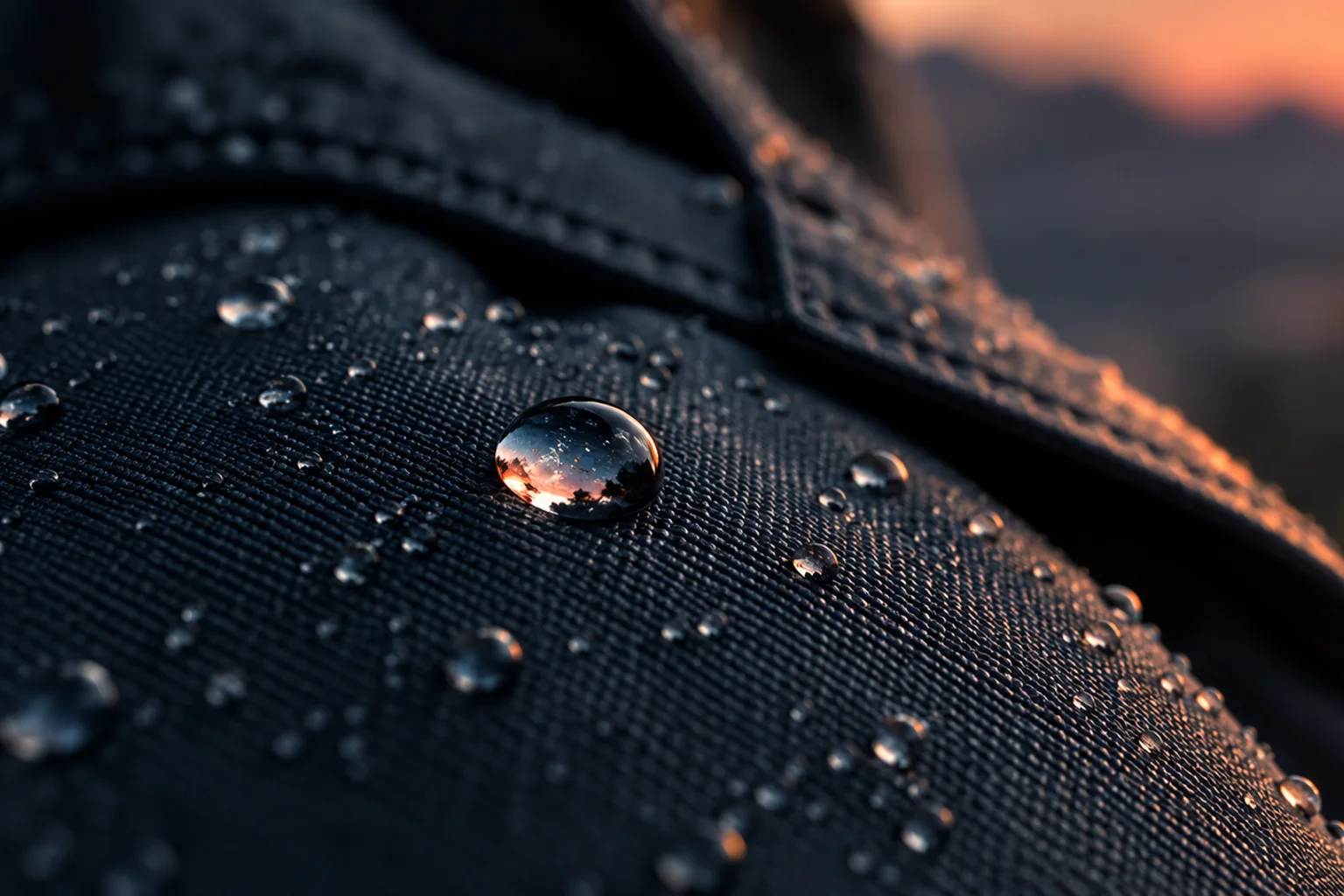
Water beads on a water-repellent outer face. If that face wets out, water spreads into the outer fabric instead. A separate intact waterproof layer can still block liquid water beneath it. Losing surface beading does not by itself show that the barrier has leaked.
Original qualitative textile sections, not a branded laminate or a contact-angle measurement. Layer separation is exaggerated. Blue is liquid water; coral is the separate barrier, not the DWR treatment. It does not show every seam, coating, face fabric or membrane chemistry.
Diagram basis: GORE-TEX: DWR, wet-out and the separate membrane.
Sources: OpenStax, Rice University · GORE-TEX Brand
A drop meets a surface, not just a color
Water molecules attract each other, creating surface tension. They also interact with the solid they touch. Those interactions affect how far a drop spreads. OpenStax illustrates the contrast with water on waxed and unwaxed surfaces: stronger wetting gives a flatter drop, while weaker wetting favors a more rounded shape.
The contact angle describes the shape where the drop meets the surface. A textile is rougher and more complicated than an ideal flat sample, but the distinction remains useful: a bead has kept a relatively small footprint instead of soaking across the face.
Sources: OpenStax, Rice University
The outer treatment helps water leave the face fabric
DWR stands for durable water repellent. GORE-TEX describes it as a thin treatment on the garment's outermost fabric that helps water bead and roll off. It changes the surface's wetting behavior; it doesn't turn liquid water into a different substance.
Durable also doesn't mean permanent. Wear and contamination can reduce beading. Then the face fabric can take up water and feel damp. That visible change is at the outside of the garment and isn't, by itself, proof of a hole through its waterproof layer.
Sources: GORE-TEX Brand
A wet face and a leaking membrane are different conditions
When the face fabric wets out, water occupies that outer layer. An intact membrane can still prevent the same liquid from passing through to the inside. Water location matters more than whether the jacket looks darkened by rain.
Sources: GORE-TEX Brand · OpenStax, Rice University
The thing to remember
Beading is a surface-wetting behavior. Waterproofing is a barrier function, so loss of beading doesn't automatically mean the membrane leaks.
What this example leaves out
The figure simplifies a treated outer fabric over an intact waterproof layer. It does not specify a membrane chemistry, contact angle, water-pressure rating or universal care procedure. Construction and care requirements vary; follow the garment maker's care label.
Sources & further reading
Source access dates are listed below. Manufacturer descriptions and patents support the specific constructions described, not every product.
- 11.8 Cohesion and Adhesion in Liquids — Adhesion and Capillary Action ↗
OpenStax, Rice University · Retrieved 2026-10-16 · Relative solid/liquid interactions affect drop spread, contact angle and beading; surface tension role.
Actual contact-angle explanation and waxed/unwaxed comparison read. Qualitative ideal-surface model; textile roughness acknowledged. No numerical jacket contact angle inferred. - Frequently Asked Questions — Durable Water Repellent ↗
GORE-TEX Brand · Retrieved 2026-10-16 · Outer DWR treatment promotes beading; face fabric may wet while membrane remains waterproof; treatment loses performance; garment care label matters.
DWR sections and care-label passages read. Loose phrase surface tension of fabric not copied; no universal reheating, chemistry, environmental, warranty or pressure-rating advice.