Look a little closer
See the mechanism
Printing and fading are different changes
Read the diagram
A reactive coating makes the image. A heated print head locally activates the dye/developer coating to form a dark image. Later exposure can change the image-forming chemistry or darken the background. This sequence separates printing from deterioration; it does not predict a storage lifetime.
Qualitative coating sections. The second image is an illustration of loss of contrast, not an aging test. Direct thermal paper, not thermal-transfer ribbon printing.
Diagram basis: Koehler Paper: thermal-paper technology.
Sources: Koehler Paper · Koehler Paper SE · Koehler Paper
The printer heats the paper instead of adding ink
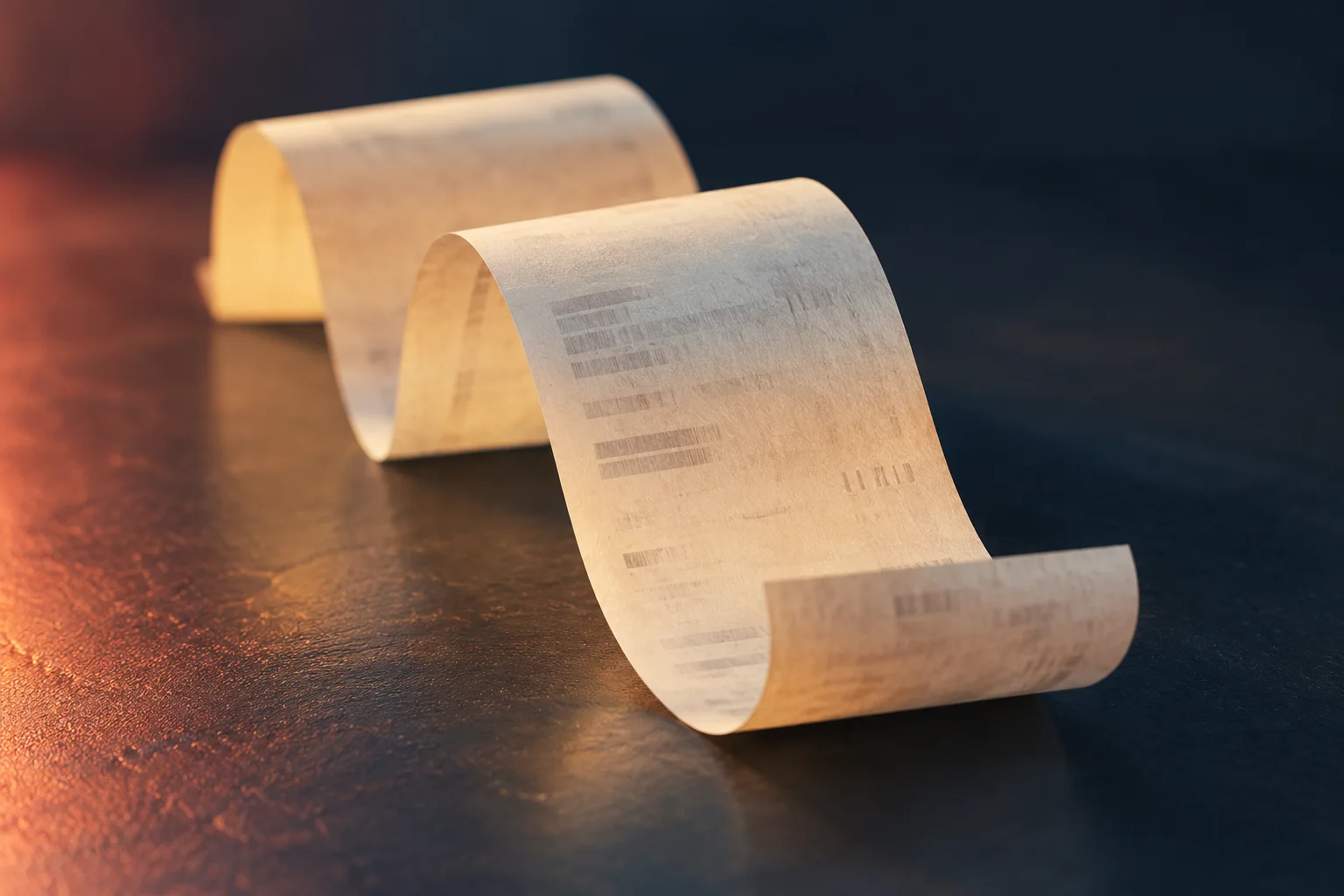
A direct thermal printhead has many small heating elements. It switches them on in a pattern, triggering a color reaction in the coating beneath them. Those darkened dots build the receipt's letters and bars.
Koehler identifies color-forming substances and a developer as the main functional ingredients. The visible mark is therefore part of a treated surface. It isn't an ordinary layer of printer ink that must physically flake off for the words to disappear.
Sources: Koehler Paper
Two ways to lose a readable image
A dark mark can become paler, but the surrounding paper can also become darker or discolored. Either reduces the difference your eyes need to distinguish text. A receipt that looks blank and one that looks gray all over need not have changed in the same way.
Koehler's durability guidance lists sunlight, prolonged heat, moisture, plasticizers from PVC, oils, fats and alcohol among influences that can shorten print life. Its guarantees have specified paper and storage conditions; they aren't a lifespan for an unidentified receipt in a wallet.
Sources: Koehler Paper SE
Thermal paper is a family
Some thermal papers have protective coatings. There are also different image-forming technologies: Koehler's blue Blue4est paper is made without conventional color developers. A receipt's color and construction can therefore matter when comparing how it ages.
Sources: Koehler Paper · Koehler Paper
The thing to remember
A fading receipt is a change in an image-forming surface, not necessarily damage to the sheet that carries it.
What this example leaves out
This covers conventional direct thermal paper. It does not identify the formulation of a particular receipt, assign one chemical fading pathway to every exposure, or promise that a storage method will preserve a record.
Sources & further reading
Source access dates are listed below. Manufacturer descriptions and patents support the specific constructions described, not every product.
- Functional principle ↗
Koehler Paper · Retrieved 2026-10-17 · Heated dots trigger color reaction in coating containing color former/developer; optional protective coatings.
Conventional direct thermal paper; no precise fading reaction inferred. - Durability of Koehler Thermal Paper ↗
Koehler Paper SE · Retrieved 2026-10-17 · Storage/exposure influences on contrast, discoloration and print durability.
Manufacturer product conditions; time guarantees not generalized to unidentified receipts. - Thermal Paper ↗
Koehler Paper · Retrieved 2026-10-17 · Blue4est is a different thermal technology without conventional color developer.
Used only as construction boundary, not environmental or storage claim.