
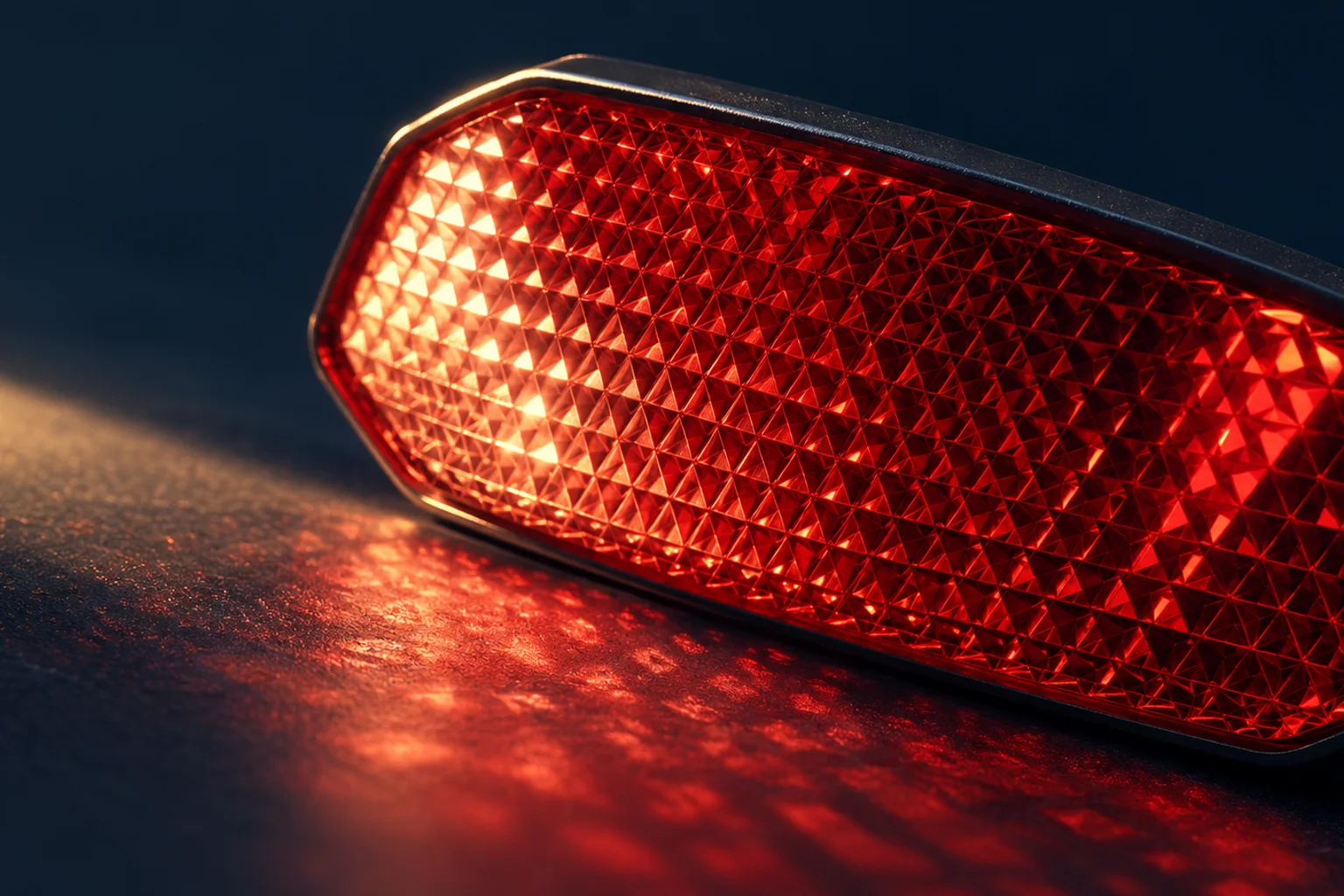
Look a little closer
See the mechanism
Each face flips one direction component
Read the diagram
The three reflecting faces meet at right angles in three dimensions. This computed example ray strikes each face once. Each reflection reverses one perpendicular direction component, so after three reflections the outgoing direction is opposite and parallel to the incoming direction. The returned ray can be laterally displaced rather than retracing its path.
Original orthographic projection of three mutually perpendicular planes; apparent screen angles are not the physical right angles. The ray was solved in 3D before projection, with all three impacts within the triangular opening. No glow, exact retracing, optical efficiency or unlimited acceptance angle is implied. Road products can instead use glass beads or solid microprisms.
Diagram basis: Edmund Optics: three first-surface mirrors; OpenStax: three-dimensional corner reflection.
Sources: 3M Road Safety · Edmund Optics
A flat mirror sends the beam elsewhere unless the angle is right
One mirror changes a ray's direction according to its angle of arrival. A retroreflective structure uses a sequence of optical changes so the outgoing direction points back toward the incoming source over a useful range of angles.
3M describes the returned light as a cone rather than an infinitely thin line. Your eye is near a vehicle's headlights, not inside them, so that spread helps explain why you can see the sign. Observer position still matters: a reflector needn't look equally bright from every viewpoint.
Sources: 3M Road Safety
Three faces can reverse the direction in three dimensions
A corner cube uses three reflecting faces arranged like the inside corner of a box. A suitable incoming ray reflects from all three. The sequence reverses its direction, sending it back approximately parallel to its arrival path. The outgoing ray can be displaced sideways; returning toward the source doesn't require retracing the exact same line.
Edmund Optics makes a hollow version from three first-surface mirrors. Molded prism reflectors package the optical idea differently: their small corner structures repeat across a sheet rather than forming one large hollow assembly.
Sources: Edmund Optics · 3M Road Safety
A bead takes a different route to the same aim
In 3M's glass-bead explanation, light bends as it enters a bead, reflects from a surface behind it and bends again on the way out. The sequence returns light toward the source without using the same three-face geometry.
Neither approach makes a passive reflector glow after the incident light is removed. And neither guarantees the same return at arbitrary entrance and observation angles. Cell geometry, material and the observer's position help determine what comes back to the eye.
Sources: 3M Road Safety · Edmund Optics
The thing to remember
Retroreflective optics steer incident light back toward its source. Beads and corner structures achieve that return through different paths.
What this example leaves out
The figure selects an ideal corner-cube principle; a bead is described separately. Real reflectors have finite entrance and observation ranges. It is not a visibility certification, brightness measurement or drawing of every bicycle reflector.
Sources & further reading
Source access dates are listed below. Manufacturer descriptions and patents support the specific constructions described, not every product.
- What is retroreflectivity and why is it important? ↗
3M Road Safety · Retrieved 2026-10-16 · Glass-bead refract/reflect/refract path; three-face corner reflection; returned cone and observer-angle dependence.
Actual Additional insight and cone/observation-angle paragraphs fetched/read directly after web find failed. No product superiority, road-safety certification or brightness comparison adopted. - Hollow Retroreflectors ↗
Edmund Optics · Retrieved 2026-10-16 · Three first-surface mirrors in corner-cube arrangement return a ray parallel toward its source.
Actual product explanation returned/read by web. Direct fetch later challenged. Infinite angle-independence wording bounded to physically accepted entrance paths; ideal direction reversal is geometry synthesis, no actual3Dray graphic reviewed.