
Look a little closer
See the mechanism
The difference starts between the rolls
Read the diagram
Two thin sheets pass through the rolling gap together. Their outward faces touch the rolls and emerge shiny; their inward faces touch each other and emerge dull. Separating the sheets leaves each sheet with one of each face.
Original process schematic, not to scale. Sheet thickness and separation are exaggerated. Coral marks roll-contact faces; the dashed line marks sheet-to-sheet contact. This explains ordinary paired-rolled foil, not a separately applied non-stick coating.
Diagram basis: Reynolds: shiny and dull sides; EAFA: double rolling and separation.
Sources: European Aluminium Foil Association · Reynolds Brands · Reynolds Brands
Two sheets pass through together
Foil starts thicker than the sheet you tear from a kitchen roll. Rolling reduces that thickness through successive passes. For very thin foil, the last stages can put two layers through the rollers at once. The European Aluminium Foil Association calls this double rolling.
Picture the pair as a sandwich with no filling. There are four faces: two outside, and two touching in the middle. After rolling, the sheets separate. Each takes one outer face and one contact face with it. Neither finished sheet has an inside layer that you need to peel away.
Sources: European Aluminium Foil Association
The contrast is a trace of contact
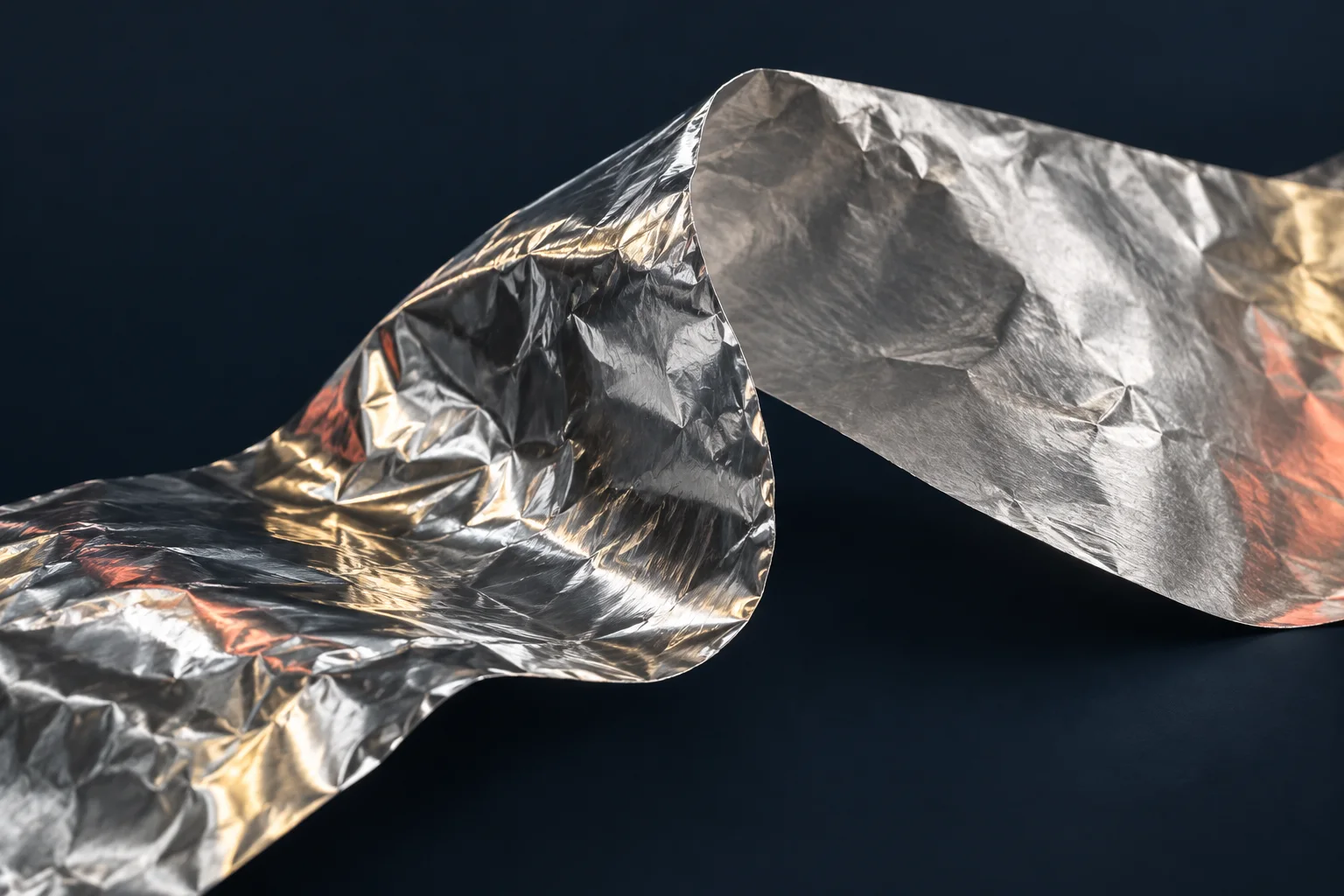
Reynolds describes the contact faces as dull and the faces that weren't pressed against another sheet as shiny. When the pair separates, each sheet keeps one matte contact face and one shiny outer face. The contrast comes from how the two sides passed through the mill together.
A fold makes the result easy to recognize: the same piece can present a bright patch beside a quieter gray one. That contrast records how the surfaces were made. It isn't a printed instruction about which way to wrap your lunch.
Sources: Reynolds Brands · European Aluminium Foil Association
The label matters more than the shine
For its standard and heavy-duty foil, Reynolds says either face can touch food. There is no need to turn an ordinary sheet over because you chose the dull face.
Reynolds Non-Stick Foil and Grill Foil do specify a food-facing surface: their dull face carries the non-stick treatment. The non-stick product is marked to identify that side. So the useful distinction is ordinary versus specially treated foil, rather than shiny versus dull on its own. Check the packaging when the product changes.
Sources: Reynolds Brands · Reynolds Brands
The thing to remember
Two sheets rolled together acquire different inner and outer faces. Ordinary kitchen foil can face either way; a specified coating can make the choice matter.
What this example leaves out
This explains double-rolled ordinary foil and the named manufacturer's non-stick exception. The schematic exaggerates thickness and separation. It does not compare heat reflectance, cooking times, product safety or all coated foils.
Sources & further reading
Source access dates are listed below. Manufacturer descriptions and patents support the specific constructions described, not every product.
- Facts and Properties — Making aluminium foil ↗
European Aluminium Foil Association · Retrieved 2026-10-16 · Successive rolling, simultaneous rolling of two thin layers, matte contact faces and subsequent separation.
Relevant manufacturing passage read, lines 76–79. Paired-sheet figure is an original schematic with exaggerated thickness. No market, environmental or safety statements adopted. - Heavy Duty Foil — Product FAQs ↗
Reynolds Brands · Retrieved 2026-10-16 · Two-layer milling produces different faces; manufacturer permits either face of standard/heavy-duty foil to contact food.
FAQs What side of the foil should I use? and What is the difference between the shiny and dull sides? read. Cooking interchangeability is not generalized to identical spectral reflectance. - The Complete Guide on How to Use Reynolds Aluminum Foil ↗
Reynolds Brands · Retrieved 2026-10-16 · Ordinary foil faces interchangeable for cooking; dull face of Reynolds Non-Stick and Grill Foil is the designated non-stick face; marking identifies it.
Opening two FAQ sections read. Brand-specific coating exception only; no temperature, safety, history, or cooking-performance figures adopted.