
Look a little closer
See the mechanism
Swirl spreads liquid before it breaks apart
Read the diagram
From chamber to droplets. Pressurized liquid enters a swirl chamber through tangential passages. The rotating flow exits a small orifice and spreads as a thin sheet. That sheet becomes unstable and breaks into ligaments and droplets. The pump supplies pressure; this selected nozzle shapes the exiting flow.
Functional pressure-swirl atomizer, not every trigger sprayer. The top view and exit section use different scales. Droplet paths and sizes are illustrative, with no spray-angle or size claim.
Diagram basis: US4503998A: tangential swirl chamber and exit orifice.
Sources: US patent / named inventor disclosure · PLOS ONE / study authors
The trigger supplies flow; the front cap redirects it
Squeezing a trigger moves a pump piston and raises the liquid pressure. That pressure drives liquid along the discharge passage toward the nozzle. A small outlet alone does not explain the whole spray pattern: the route immediately behind the outlet matters too.
Patent US4503998A describes an insert, an elastic cup and a threaded cap. Passages feed a shallow swirl chamber in the cup's front face. With the cap in the spray position, this confined route gives the liquid angular momentum before it leaves the cap's central orifice.
Mist is still liquid water
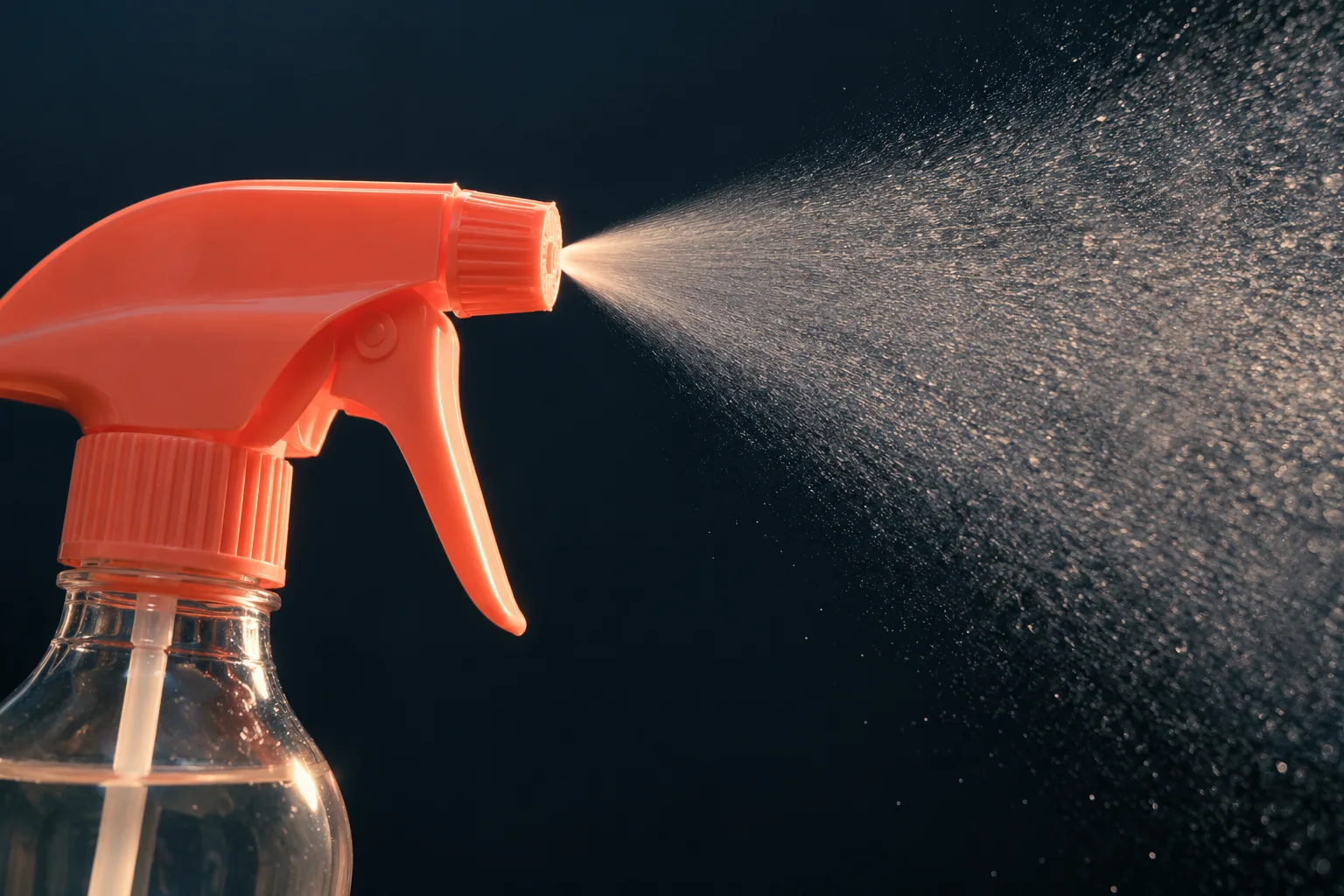
The moving liquid spreads into a much thinner structure outside an atomizing outlet. A sheet can stretch, develop disturbances and break into narrow threads called ligaments. The ligaments then separate into drops. The visible cloud is those small liquid drops scattering light, rather than water becoming a gas.
High-speed imaging in a study of a nasal spray distinguishes sheet, ligament and droplet regions. That research helps explain the breakup sequence; its particular pressures, dimensions and droplet measurements do not describe a household trigger bottle.
The liquid's properties matter along with the nozzle. A thicker formulation can resist deformation differently from water. The same cap therefore does not establish the same droplet sizes for every cleaning liquid.
Sources: PLOS ONE / study authors
A stream setting can weaken the swirl
In the patent's example, moving the cap farther away changes the liquid's confinement. The flow no longer stays in the shallow swirl chamber in the same way, gains little angular momentum and leaves as a stream.
That is a mechanical change to the route, not simply a larger hole punched through the front. Other sprayers use different selectors, but the useful question remains where the cap sends the pressurized liquid before it exits.
The thing to remember
Look behind the outlet: the nozzle's channels turn pump pressure into a particular flow pattern, and breakup turns that flowing liquid into drops.
What this example leaves out
The cap-and-cup arrangement is one patented design, not proof of the internals of an unmarked bottle. The sheet-breakup study concerns a nasal atomizer. No universal droplet size, spray distance or safe chemical substitution is implied.
Sources & further reading
Source access dates are listed below. Manufacturer descriptions and patents support the specific constructions described, not every product.
- US4503998A — Trigger sprayer ↗
US patent / named inventor disclosure · Retrieved 2026-10-17 · Trigger/piston feeds pressure; insert/elastic cup/swirl chamber/orifice; axial cap movement changes spray to stream.
Disclosed nozzle example only, not identification of generic bottle internals. - Primary break-up and atomization characteristics of a nasal spray ↗
PLOS ONE / study authors · Retrieved 2026-10-17 · Observed sheet/ligament/droplet sequence and effect of liquid properties on breakup.
Nasal atomizer study, used only for general breakup sequence; no household bottle dimensions or measurements transferred.