Look a little closer
See the mechanism
The container helps return material to the blades
Read the diagram
Rotating blades move liquid outward near the bottom. In a freely circulating mixture, material returns upward near the container walls and back inward toward the center. A depressed free surface can appear above the downward central flow. Thick mixtures may circulate differently or stop feeding the blades.
Original qualitative liquid-flow section, not CFD or a universal free-surface shape. Arrows show a representative circulation route, not all local motion or measured speeds. No guarantee of a vortex in every viscosity, fill or container geometry.
Diagram basis: Vitamix: container geometry and return circulation.
Sources: Vitamix · Vitamix · MIT Weather in a Tank · Vitamix · KitchenAid New Zealand · MIT Weather in a Tank
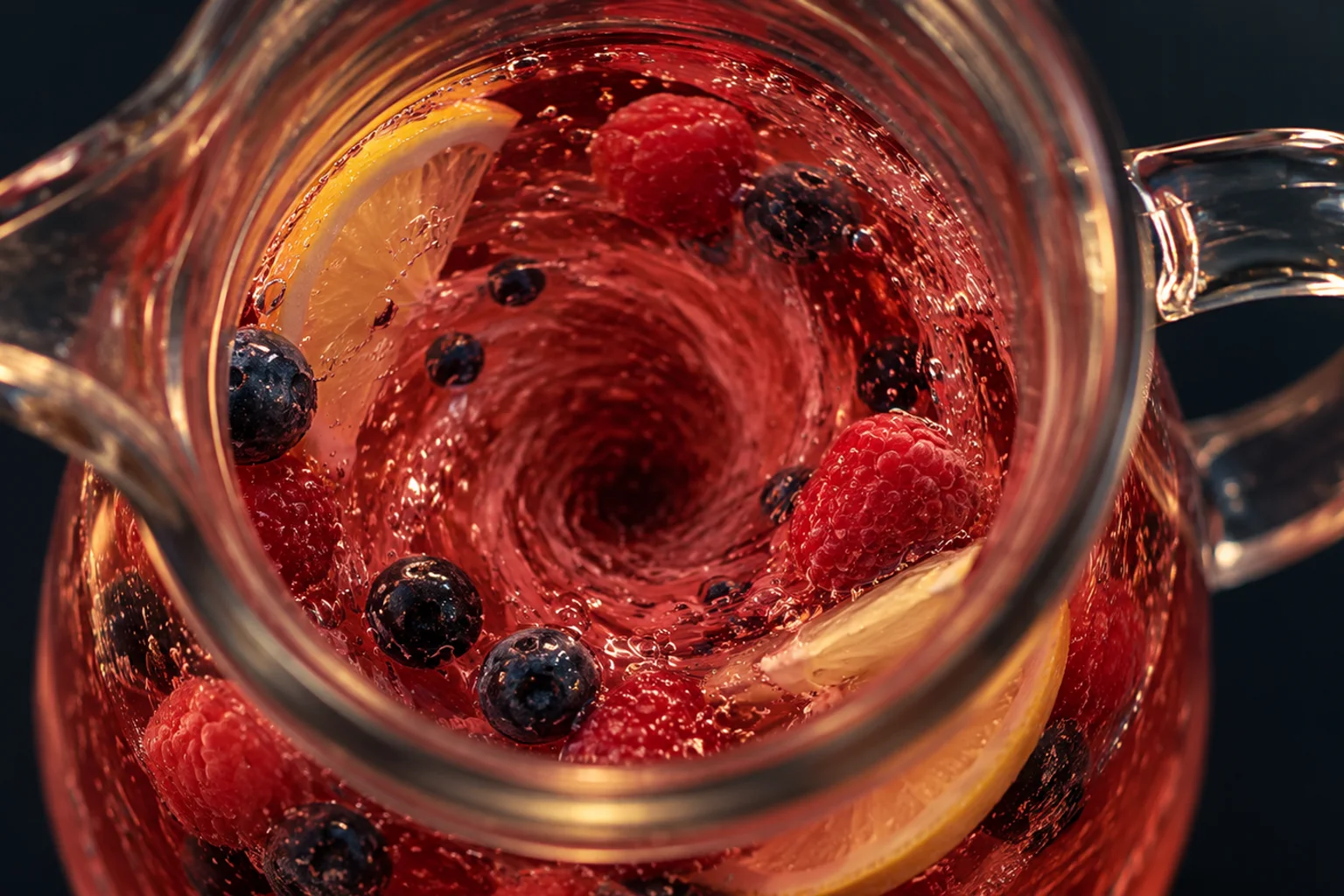
A spinning liquid needn't have a flat surface
Water at rest in an upright container has a level free surface. Rotation changes the balance of forces within it. In the frame of a rotating tank, water responds to an outward centrifugal effect as well as downward gravity. Its surface slopes to match that combined direction: lower near the axis, higher toward the outside. MIT's rotating-tank demonstration makes the change visible.
A blender is more complicated than that steady rotating tank. Its blades, container walls and ingredients produce a changing flow. The comparison explains why rotation and a central surface depression can go together; it doesn't prescribe a perfect mathematical funnel for every smoothie.
Sources: MIT Weather in a Tank · MIT Weather in a Tank
The walls help return material to the blades
The blades work near the bottom, but ingredients occupy much of the container. Turning the blade assembly is useful only if material reaches that working region. Vitamix describes shaping its containers to pull ingredients through the blades' path and fold them back into the flow.
That connects the visible vortex to the container around it. The walls aren't merely packaging for the liquid. They constrain where moving material can go, helping create a circulation that repeatedly brings ingredients toward the blades instead of leaving all the action in one small bottom layer.
A funnel shows motion, not a finished result
The surface tells you something is moving, but it doesn't reveal every path beneath it or prove that all pieces have passed the blades equally. Vitamix notes that thick or frozen blends can stop circulating freely, with air pockets developing near the blades. A spinning tool can then lose the continuous supply of ingredients it needs.
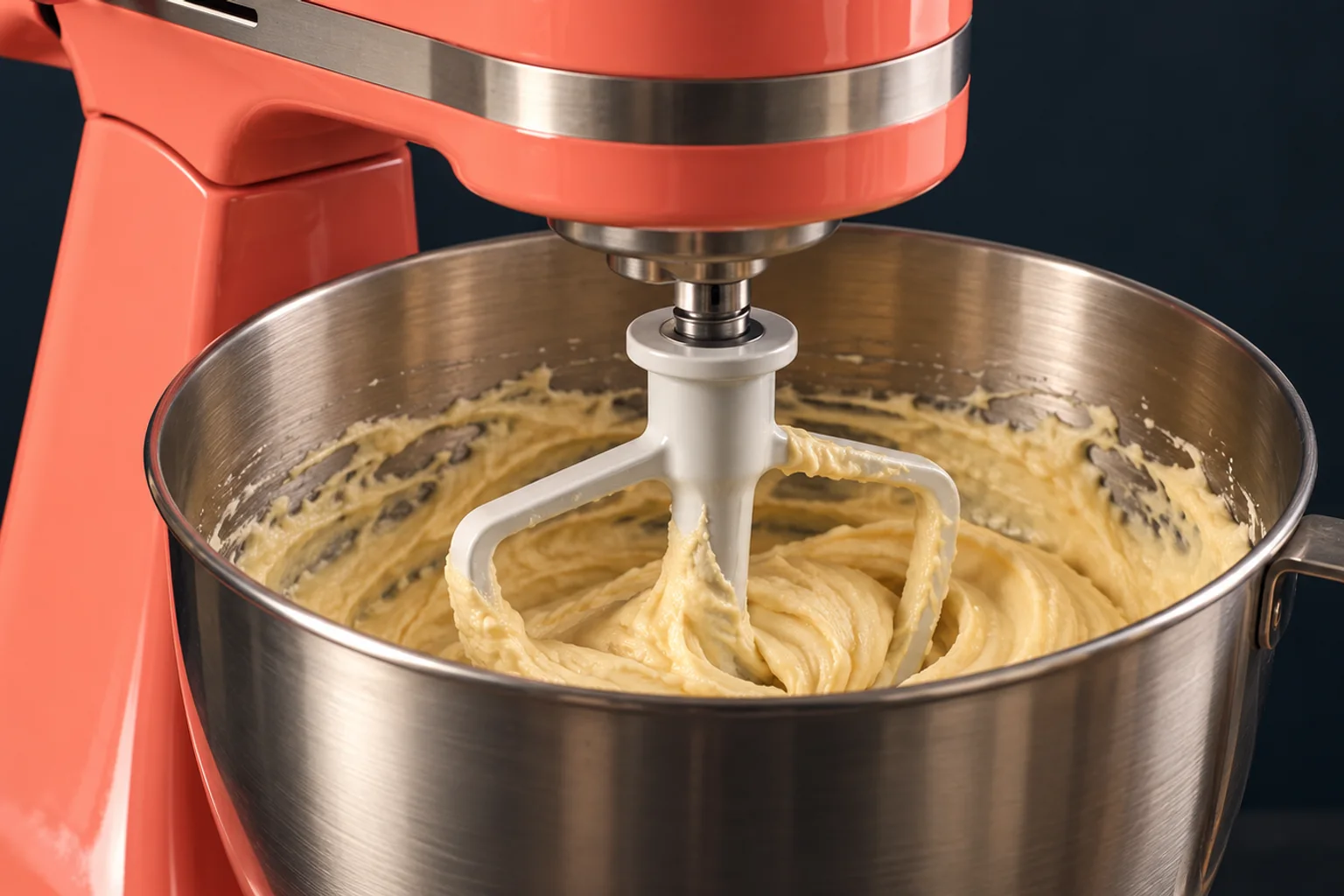
Nor does every mixture flow like water. A thick paste and a freely moving liquid can meet the same spinning blades in very different ways. In a planetary stand mixer, the tool itself travels around the bowl. In a blender, the tool stays at its mounting point and relies on the contents moving toward it. That difference is easier to see when you look past the funnel at the top.
Sources: Vitamix · Vitamix · KitchenAid New Zealand
The thing to remember
The vortex is the visible surface of a circulating mixture. The blade supplies motion, while the container helps material return to the blade region.
What this example leaves out
The circulation example follows Vitamix's container explanation. MIT's solid-body rotating tank supplies a limited fluid-mechanics comparison, not a blender simulation. The schematic doesn't measure mixing completeness, flow speed or the behavior of every thick mixture.
Sources & further reading
Source access dates are listed below. Manufacturer descriptions and patents support the specific constructions described, not every product.
- How We Built a Better Blender ↗
Vitamix · Retrieved 2026-10-16 · Container shape guides ingredients through blades' working path and contributes to visible vortex.
Power and performance container-design paragraph read, web lines19–24. Brand durability tests, motor values and universal claims about blunt blades excluded. - 48-Ounce Container ↗
Vitamix · Retrieved 2026-10-16 · Named container's angles create controlled vortex and fold ingredients back to blades.
Relevant product design passage read on opened review-parameter URL, canonical product URL retained. Qualitative example only; no CFD, efficiency or mixing-completeness result inferred. - Solid Body Rotation: Introduction — Weather in a Tank ↗
MIT Weather in a Tank · Retrieved 2026-10-16 · Rotating-tank water reaches solid-body rotation with a curved/parabolic free surface; rotation changes equilibrium shape.
Complete short introduction and caption read, web lines11–14. A limited physical comparison, not a blender model: no universal paraboloid, liquid speed or blender force field claimed. - Frequently Asked Questions — Use the Tamper ↗
Vitamix · Retrieved 2026-10-16 · Thick/frozen blends can stop circulating freely and develop air pockets near blades.
Relevant text paragraphs read, web lines12–17 and42–46. No operational tamper, speed or loading instructions reproduced; manual/model-specific use remains separate. - FAQs — What is Original Planetary Mixing Action? ↗
KitchenAid New Zealand · Retrieved 2026-10-16 · Flat beater orbits stationary bowl while turning the opposite direction about its own axis; attachments can differ.
Full FAQ mechanism paragraph read, web line626. Quantitative coverage and speed-superiority marketing excluded. PDFs W11647986A/W11287557 were opened but causal text wasn't successfully re-extracted; direct PDF fetch timed out, so those manuals aren't represented as fully read evidence. - Solid Body Rotation: Theory — Weather in a Tank ↗
MIT Weather in a Tank · Retrieved 2026-10-16 · In solid-body rotating frame, combined downward gravity/outward centrifugal effect gives a tilted parabolic free surface.
Complete short theory page read, web lines9–17. Article uses a qualitative rotating-tank comparison, not an exact model of turbulent blender flow. Numeric demonstrations and equations not transplanted.