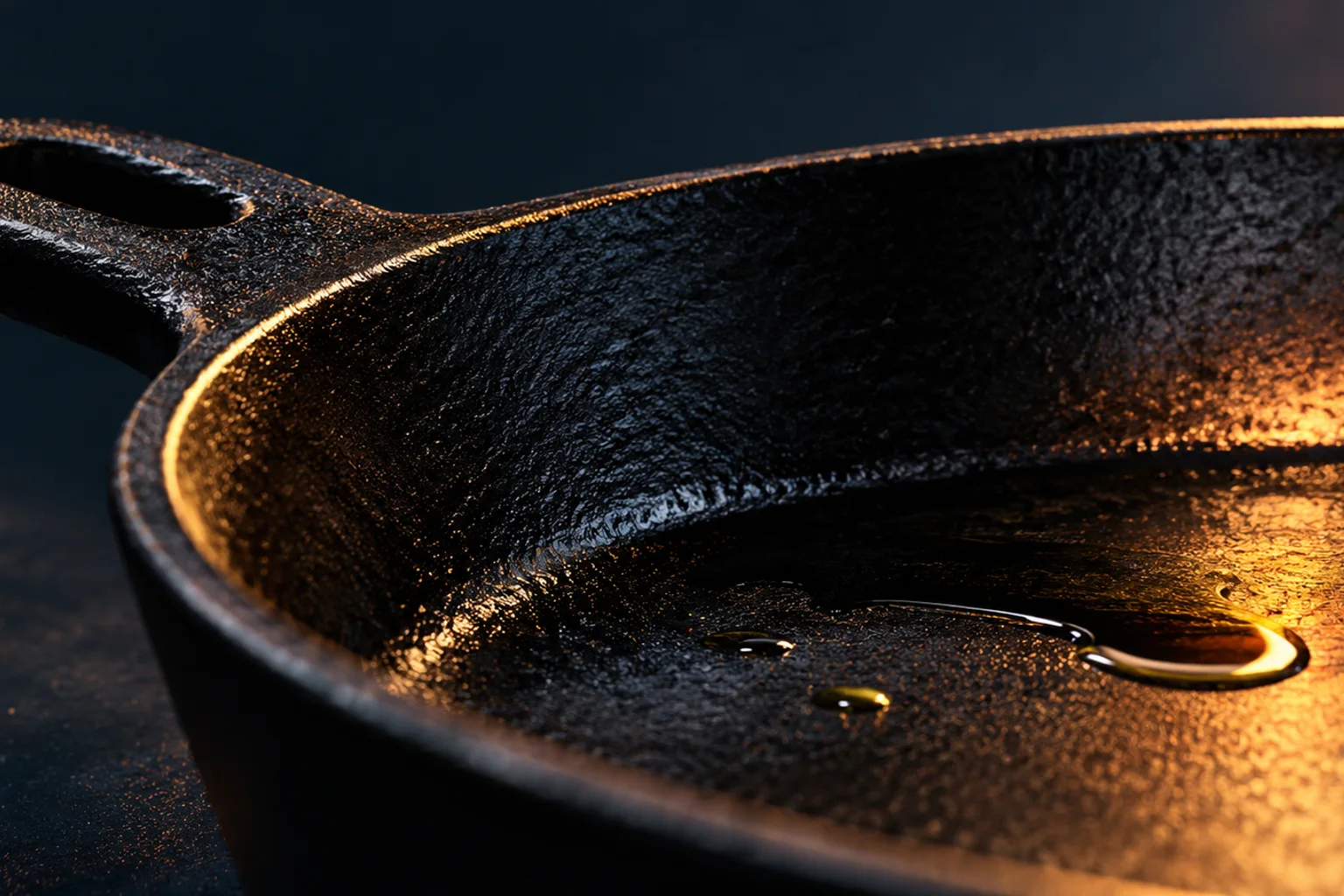
Look a little closer
See the mechanism
A thin coating, changed by heat
Read the diagram
A thin oil film is liquid before heating. Heating can turn oil into a hardened seasoning layer through polymerization. That layer follows the iron surface; wear can expose a local patch. A wet oil coating and hardened seasoning are different states, even though both begin with oil.
Original exaggerated cross-sections. Thickness and surface roughness are illustrative, not measurements. The diagram does not specify molecular structures, ideal oil, recipe temperature, safety claims or identify every dark residue as seasoning.
Diagram basis: Lodge: seasoning as polymerized oil.
Sources: Lodge Cast Iron · Lodge Cast Iron
The coating starts as oil, but doesn't stay liquid
A wipe of oil and a seasoned surface can both look glossy, but they aren't the same state of the material. Lodge describes seasoning as oil heated into a hardened surface through polymerization. The coating stays with the pan after the loose liquid oil is gone.
The visible change separates seasoning from a fresh wipe of oil. Before heating, the oil can flow across the surface; after the coating forms, a hardened layer remains. That layer can give the pan an easier-release cooking surface. Adding more liquid oil for cooking is a further step, rather than a replacement for the coating beneath it.
Sources: Lodge Cast Iron
A large puddle isn't a thicker finished coating
Lodge's seasoning method specifies a very thin application of oil, without enough to run or drip. That instruction follows the difference between putting oil on the pan and creating a useful surface from it. The amount of wet oil isn't a direct measure of the finished coating's quality.
Further cooking with oil can add to the layer. The result need not be perfectly uniform at first: Lodge notes that cooking conditions and hot spots affect where the film develops. A changing patch of color can be part of a surface building up over time, rather than a factory-applied sheet of constant thickness.
Sources: Lodge Cast Iron
The iron and its coating do different jobs
The pan remains cast iron beneath the seasoning. Its mass and shape belong to the cookware itself; the thin coating changes the cooking surface. If part of that coating wears away, there is still a pan underneath, with a locally different exposed surface.
Manufactured nonstick coatings provide another way to change a pan's surface, but seasoning isn't a name for all of them. Here the layer forms from heated oil on the iron. Its history of buildup and wear is why two well-used cast-iron pans need not have the same-looking finish. Lodge also distinguishes a hardened surface from loose flakes that can come away when seasoning breaks down.
Sources: Lodge Cast Iron · Lodge Cast Iron
The thing to remember
Seasoning is oil transformed into a coating. Its condition depends on the layer that forms and remains on the pan, not just the amount of oil added.
What this example leaves out
This is a qualitative account of oil-based cast-iron seasoning using Lodge's explanation and care method. It doesn't rank oils, prescribe one temperature for every product or assess a particular black residue from its color.
Sources & further reading
Source access dates are listed below. Manufacturer descriptions and patents support the specific constructions described, not every product.
- How to Season ↗
Lodge Cast Iron · Retrieved 2026-10-16 · Heated oil forms hardened seasoning via polymerization; thin oil application and patchy buildup influenced by cooking conditions.
What is seasoning?, Apply oil and The best seasoning? Cooking passages read, web lines86–105. No specific reaction pathway, ideal oil, universal temperature/time, health claim or quantitative film thickness adopted. - How to Fix Common Cast Iron Concerns ↗
Lodge Cast Iron · Retrieved 2026-10-16 · Seasoning can break down/flakes can be carbonized oil; excess oil can cause sticky surface; coverage can be uneven.
Black flakes, sticky/gummy surface and uneven appearance paragraphs read, web lines100–119. No claim identifying every black residue or offering health assessment; restoration instructions not reproduced.