
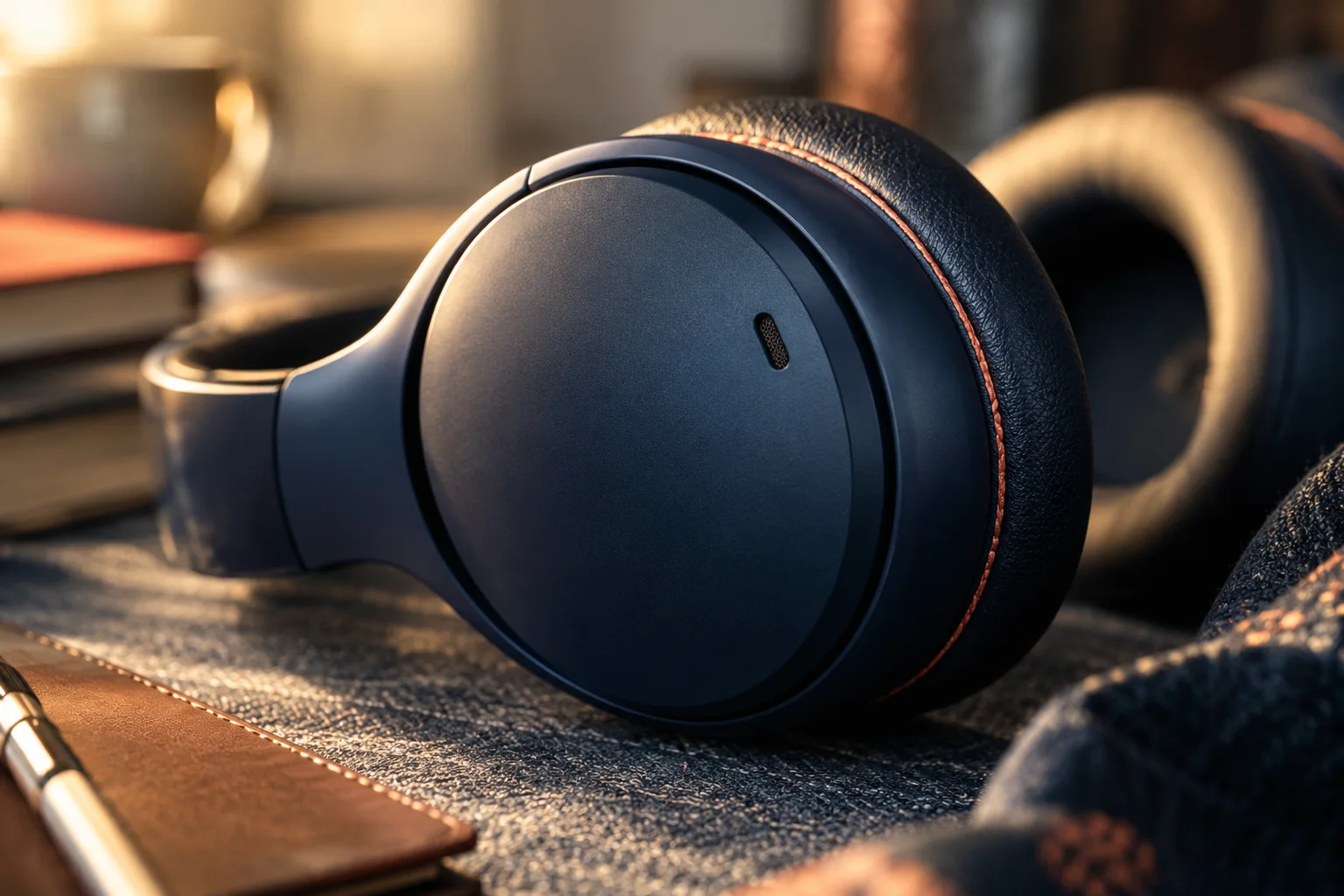
Look a little closer
See the mechanism
Opposing pressure reduces the total at the ear
Read the diagram
Functional sound paths. A microphone samples sound and the controller drives the speaker to add an opposing pressure contribution at the listening position. The resulting pressure is the sum of the arriving noise and speaker sound. Timing and the acoustic path matter; this idealized steady tone shows reduction, not perfect broadband silence.
Functional causal map and idealized pressure traces, not an engineering wiring or microphone-layout diagram. The traces share an arbitrary time axis and pressure scale; passive isolation and real residual noise are not quantified.
Diagram basis: Analog Devices: active noise cancellation.
Sources: Analog Devices · Bose · Analog Devices technical wiki
Microphone, controller, driver
A microphone turns changing air pressure into an electrical signal. The ANC controller processes that signal and drives the headphone speaker, or driver. Electrical energy from the battery lets the driver create the additional sound.
In the hybrid arrangement described by Analog Devices, microphones outside the earcup monitor incoming noise while another microphone inside monitors sound in the listening space. The outside path is called feedforward; the inside measurement provides feedback. The controller uses these inputs to shape the correction.
Sources: Analog Devices
The pressures add at a particular place
Imagine one component of a steady hum producing a pressure increase at the ear. If the driver produces an equal decrease at that same moment and location, their sum is smaller. On the next half of the cycle, the required correction reverses. It must match the timing and size of the unwanted variation where cancellation is wanted.
The correction therefore has to account for how sound travels from the driver and from the surroundings to the ear. Simply replaying a microphone recording upside down is not enough if the paths and delay change its arrival. Fast processing matters because a late correction can miss the pressure variation it was meant to oppose.
Sources: Analog Devices · Analog Devices technical wiki
The cushion still does useful work
The earcup and cushion physically reduce the sound reaching the ear. That passive isolation acts alongside ANC. A poor seal changes the sound path as well as letting more sound through, so fit can change the result even when the electronics are operating.
Bose notes that ANC generally works best for steady low-frequency noise and less effectively for sudden, sharp or higher-frequency sounds. The system is continually measuring and correcting a changing signal, not creating a silent zone throughout the room.
Music can share the driver with the correction signal. The goal is to reduce unwanted sound while reproducing the audio you chose, so the controller cannot treat every pressure variation detected inside the cup as an instruction to eliminate all playback.
Sources: Bose · Analog Devices
The thing to remember
The useful result is the pressure sum near your ear. Microphones and electronics control an added sound so that sum contains less unwanted noise.
What this example leaves out
The example is hybrid feedforward/feedback ANC. Designs, fit and frequency response vary. This explanation does not establish a protection rating or complete cancellation of speech, impulses or hazardous noise.
Sources & further reading
Source access dates are listed below. Manufacturer descriptions and patents support the specific constructions described, not every product.
- Bowers & Wilkins’ Noise-Canceling Headphones ↗
Analog Devices · Retrieved 2026-10-17 · Hybrid feedforward/feedback external/internal microphones, ANC processing and speaker signal, fast processing.
Manufacturer case study, architecture only; performance/battery/superiority claims excluded. - What is active noise cancellation? Understanding Bose technology ↗
Bose · Retrieved 2026-10-17 · Steady low-frequency strength, sudden/high-frequency limitations, passive fit/isolation.
General manufacturer explanation; absolute silence, health and product-superiority statements excluded. - Modified FXLMS (ADAU145x) ↗
Analog Devices technical wiki · Retrieved 2026-10-17 · Cancellation point at error microphone, secondary acoustic path compensation, residual destructive-interference signal.
Algorithm example, not claim all headphones run this algorithm.