Look a little closer
See the mechanism
Surface detail shifts through a tiny view
Read the diagram steps
Reference view. An LED lights the desk. A lens images the small illuminated patch onto the sensor; the processor stores surface detail as a reference.
Mouse moves right. The same desk feature shifts left inside the sensor view. Comparing image positions yields relative movement, not an absolute desk address.
Original functional schematic; dimensions and motion are exaggerated, not measured. LED optical-navigation example. Pixel pattern is an invented explanatory feature, not a sensor capture. Image-correlation basis: US5578813A, Figures7–8.
Diagram basis: Avago ADNS-2610: Theory of Operation and optical assembly.
Sources: Avago Technologies · Hewlett-Packard Company
The desk supplies the pattern
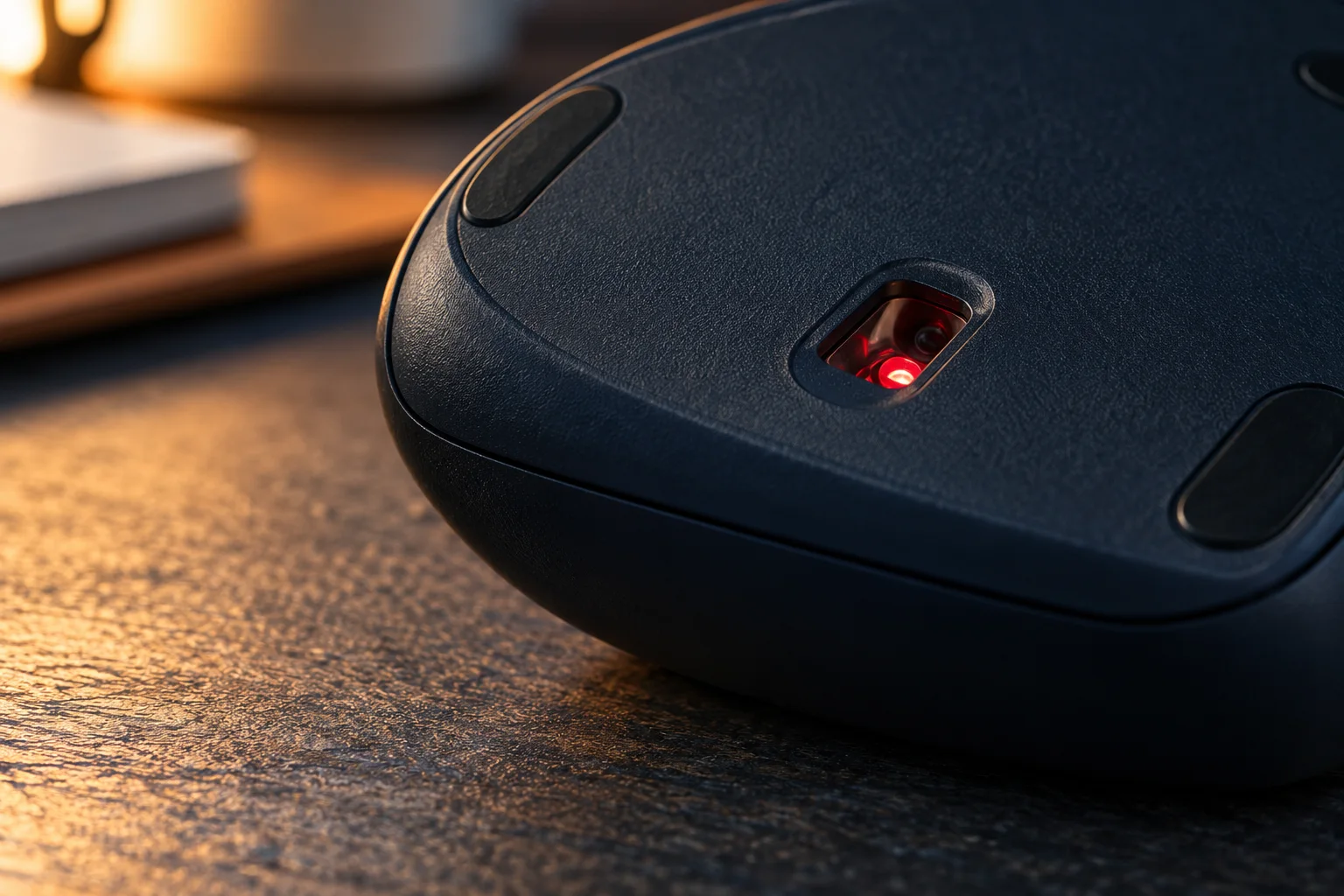
The ADNS-2610 sensor uses a lens and an illumination system to acquire microscopic surface images. The useful pattern comes from details on the surface, rather than from a ball turning inside the mouse. The opening underneath provides the optical path.
Sources: Avago Technologies
A matching pattern reveals displacement
Optical navigation can compare a reference image with a later image and find where their surface features match. When the mouse moves right, a fixed feature shifts left within its view. The calculated image shift can therefore be converted into movement of the mouse relative to the desk.
Sources: Hewlett-Packard Company
The sensor sends motion, not a desk address
The sensor's processor calculates direction and distance and exposes X and Y information to the mouse controller. Those increments describe a change in position. They do not identify a permanent absolute location on a particular desk.
Sources: Avago Technologies
The thing to remember
The mouse tracks the movement of surface detail through its small optical view.
What this example leaves out
The illustrated LED sensor is one architecture. Illumination, optics, processing and compatibility with smooth or transparent surfaces vary.
Sources & further reading
Source access dates are listed below. Manufacturer descriptions and patents support the specific constructions described, not every product.
- ADNS-2610 Optical Mouse Sensor data sheet ↗
Avago Technologies · Retrieved 2026-10-18 · Illumination, lens, microscopic surface images, digital signal processing and relative X/Y motion.
Read page 1 Theory of Operation and page 3 optical assembly description. Selected LED optical-navigation sensor; numerical performance is not generalized. - Freehand image scanning device which compensates for non-linear movement (US5578813A) ↗
Hewlett-Packard Company · Retrieved 2026-10-18 · Optical navigation by correlating surface images to determine relative displacement.
Read patent navigation-sensor/correlation passages. Supports optical-navigation principle; this patent concerns a freehand scanner, not proof of a particular mouse product.