Look a little closer
See the mechanism
A pump supplies the flow through the bed
Read the diagram
In this pump-and-thermocoil example, water moves from the reservoir through a pump and heater toward the group head. It then passes through the coffee bed and basket into the cup. The bed resists flow; the pump’s headline rating is not a measurement of pressure at every stage of brewing.
Original functional layout, not a hydraulic/service schematic. It selects the BES870-style thermocoil architecture and single-wall basket; boiler and lever machines differ. Coral identifies the heater, not vapor. No invented regulator, valve topology, pressure plot or operating adjustment is shown.
Diagram basis: Breville BES870: pump, thermocoil and pre-infusion; Breville BES870 instructions: water/coffee system.
Sources: Breville · Breville · La Marzocco Home · Warren D. King; American Journal of Physics, 2008; paper mirror
Heating water doesn't make it pass through coffee
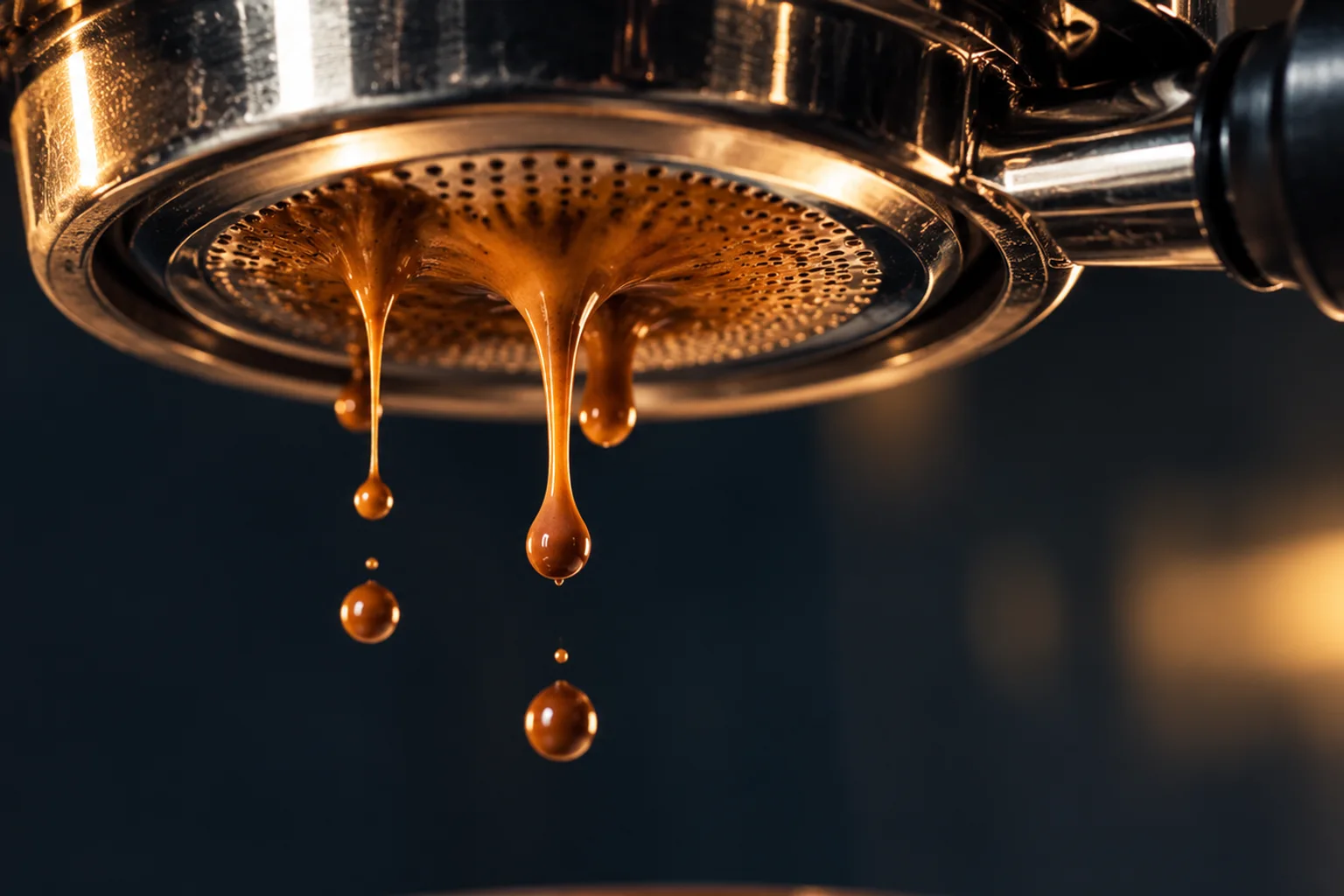
In the Breville Barista Express example, a pump moves water through a system that includes a thermocoil heater and a brewing outlet above the basket. Heating establishes the water's thermal condition. The pump creates the pressure needed to move it along the route and through the coffee.
The basket is held in a portafilter, which locates it beneath the brewing outlet. In the single-wall basket followed here, a perforated bottom lets the beverage leave while supporting the coffee bed. The portafilter's handle helps lock that assembly into the machine; it isn't the handle of a piston pressing the water downward.
The coffee leaves narrow routes for water
Ground coffee makes a porous bed rather than a solid plug. Water travels through connected spaces between particles, and that path offers resistance. The particle sizes and arrangement matter: La Marzocco describes fine particles migrating within a coffee bed and adding resistance to flow.
Pressure and flow therefore belong in the same explanation. Hot water above an empty basket would not meet the same resistance as water above a filled one. Nor does a higher number on a pump label, by itself, describe how water will move through a particular bed.
Sources: La Marzocco Home · Breville
A 15-bar pump label can accompany a 9-bar extraction
Breville's current BES870 description gives an explicit example: it lists a 15-bar Italian pump and describes 9-bar extraction. Those numbers refer to different things. The pump's rating isn't a promise that the coffee bed is brewed continuously at that rating.
The same product describes low-pressure pre-infusion before extraction. The coffee is wetted at a lower pressure before the main extraction phase, so pressure is not constant throughout the process. Other machines can control their water and pressure differently.
The pressure source distinguishes it from a moka pot
A moka pot also sends hot water through coffee, but it raises pressure by heating a trapped gas space. In this pump machine, an electric pump provides the drive. Similar ingredients and an upward or downward water path don't make the pressure source the same.
Even within espresso machines, thermocoils, boilers, rotary pumps and other components can be arranged in different ways. The useful map starts with their functions: supply water, heat it, establish a pressure difference, pass it through the coffee and let the beverage out. Exact plumbing belongs to the chosen model.
Sources: Breville · Breville · Warren D. King; American Journal of Physics, 2008; paper mirror
The thing to remember
The heater makes the water hot, the pump drives it, and the coffee bed shapes its flow. A pump rating and an extraction pressure aren't interchangeable measurements.
What this example leaves out
The named example is the thermocoil-equipped Breville BES870. The figure is a functional water-path map, not a service schematic. It doesn't specify internal regulating valves, repair steps or universal espresso pressure and temperature targets.
Sources & further reading
Source access dates are listed below. Manufacturer descriptions and patents support the specific constructions described, not every product.
- The Barista Express — BES870 ↗
Breville · Retrieved 2026-10-16 · Named example has thermocoil heating, low-pressure pre-infusion,9bar extraction and15bar pump description.
Official page lines102–115 read. Pump rating is distinguished from extraction pressure; taste claims and fixed targets for every machine excluded. Diagram is functional, not hydraulic/service detail. - The Barista Express — BES870 Instruction Manual ↗
Breville · Retrieved 2026-10-16 · Thermocoil and pre-infusion functions; filter baskets/portafilter/group head; grind affects flow; single-wall and dual-wall baskets are distinct.
112-page multilingual manual fetched; relevant English text on PDF pp3,7–9 and18–19 read with pypdf/web extraction. Not claimed fully read. No service schematic inspected, no internal valve topology or regulating component drawn. Functional diagram selects single-wall basket. - Brewing at6-Bar ↗
La Marzocco Home · Retrieved 2026-10-16 · Fine migration in coffee bed changes resistance and flow; operating pressure can differ from a conventional setting.
Fines/resistance discussion read, web lines91–92. No universal taste, exact particle distribution or guaranteed pressure/flow curve inferred. - The physics of a stove-top espresso machine ↗
Warren D. King; American Journal of Physics, 2008; paper mirror · Retrieved 2026-10-16 · Moka liquid extraction can begin without boiling; total gas pressure includes trapped air and vapor; gas expansion reduces air partial pressure as water leaves; flow depends on pressure difference and bed conductance.
Nine-page PDF fetched in memory; relevant passages on PDF pp2–3 and6 read with pypdf during source-gaps research. Mathematical glyph extraction imperfect, so no equations/numbers transcribed. Model assumptions and experimental values not universal brewing instructions; late gas breakthrough not illustrated.