Look a little closer
See the mechanism
The room temperature acts on a water valve
Read every step
- Cooler surroundings. At a lower surrounding temperature, the charged bellows exerts less closing action and the valve spring permits a larger water opening. Water can pass through the seat toward the radiator.
- Warmer surroundings. As the selected gas-charged sensing system warms, the bellows extends and pushes the valve cone toward its seat. The smaller opening reduces hot-water flow. At intermediate conditions the valve can modulate, rather than acting only as an on/off switch.
Original functional gas-charge/bellows model, not a precise RA2000 valve cutaway. The selected charge can include a small liquefied-gas portion; no generic liquid-filled capsule or gas-only assertion is drawn. Stem travel and opening are exaggerated. The return spring is omitted from view, not from the described balance. Other sensor media and electronic heads differ.
Diagram basis: Danfoss selection guide, p. 17: charged bellows and spring equilibrium.
The head senses; the valve changes the passage
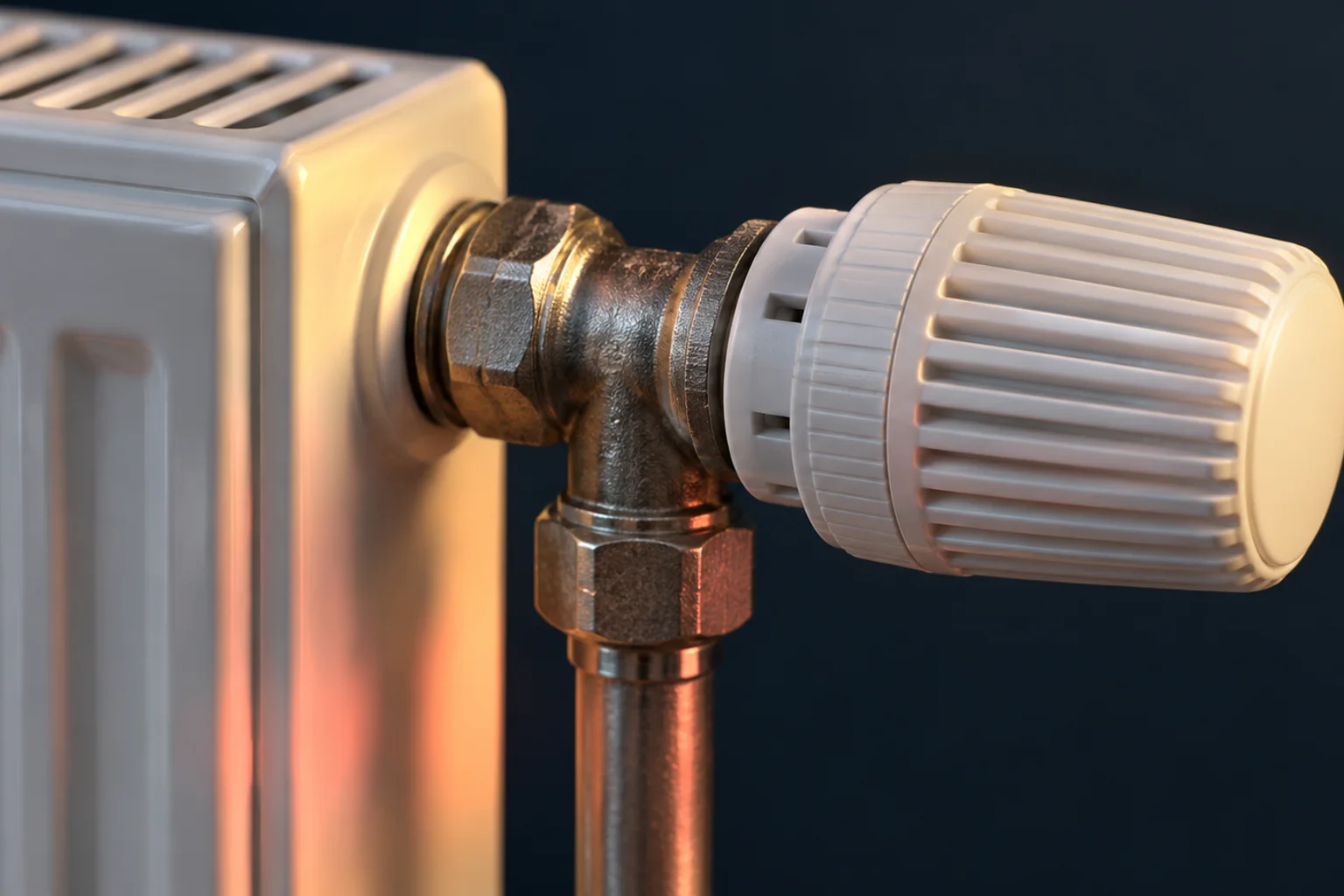
The familiar numbered head is connected to a valve in the radiator's water supply. Inside the mechanical sensor, a sealed temperature-sensitive filling acts on a flexible bellows. Movement from that assembly reaches the valve mechanism that controls the water passage.
Danfoss's RA2000 explanation uses a gas-filled, saturated-vapor sensor. The filling stays inside the sensor. It doesn't mix into the radiator water or circulate through the heating pipes. The water passage and the sensing chamber are separate parts of the device.
Warming the sensor reduces the flow
Danfoss describes the charge as a small amount of liquefied gas. Warming changes the liquid-vapor balance and raises its action on the bellows. That shifts the valve cone toward its seat against the opposing spring. The remaining opening becomes smaller, reducing the flow of hot water through the radiator.
When the sensor cools, vapor condenses and the spring allows the valve to open farther. The mechanism can settle where the bellows and spring balance, leaving an intermediate opening. A manual valve can also be left partly open, but it doesn't adjust that opening automatically as the surroundings warm or cool.
The room closes the feedback loop
More hot-water flow can supply more heat through the radiator; as the surroundings warm, the sensor then reduces that flow. A temperature drop reverses the response. The adjustment opposes the change the sensor detects, which is the core of this local feedback loop.
The dial selects the desired room condition rather than directly setting the water's temperature. Reaching a setting also doesn't mean the radiator must remain equally hot everywhere. Its job is to respond to the sensor's surroundings, not keep its own metal at one fixed temperature regardless of the room.
The thing to remember
Temperature changes inside the sensor become movement at the water valve. Warming restricts flow; cooling allows more flow in the selected gas-filled mechanism.
What this example leaves out
The example is a gas-filled Danfoss RA2000-type mechanical sensor, not the liquid-filled React or an electronic head. The schematic shows functional movement, not installation geometry, universal dial temperatures or a direct boiler-control circuit.
Sources & further reading
Source access dates are listed below. Manufacturer descriptions and patents support the specific constructions described, not every product.
- The inner workings of the thermostatic radiator valve ↗
Danfoss · Retrieved 2026-10-16 · Mechanical gas-filled bellows changes valve opening and water flow as surrounding temperature changes; other sensor media/electronic heads differ.
Actual causal paragraphs read, web lines20–28. No numerical reaction-time, superiority, service-life or energy claim adopted. Technical guide supplies the more precise saturated-vapor charge description. - Commercial Product Selection Guide — Built-in Sensors RA-2000 ↗
Danfoss · Retrieved 2026-10-16 · RA2000 bellows contains a small liquefied-gas charge; warming state change modulates closed, cooling condensation permits spring-driven opening, equilibrium between bellows and spring pressures; intermediate valve-cone position.
Current URL resolved to112-page Commercial Product Selection Guide, not an isolated sensor sheet. Downloaded and complete printed/PDF p17 read with pypdf. No whole-guide or exact cutaway-pixel inspection claimed. Gas-filled must not be represented as necessarily gas-only or confused with liquid-filled React.