
Look a little closer
See the mechanism
A lift rod reverses motion through a lever
Read the diagram steps
Lift rod down, stopper up. Pushing the lift rod down moves the outer end of the pivot lever down. The lever turns at its ball joint, raising the inner end and the stopper. Water can enter the drain around the raised stopper.
Lift rod up, stopper down. Pulling the lift rod up raises the outer lever end. The inner end drops and lowers the stopper onto the drain opening. This selected linkage differs from a push-to-click stopper.
Functional lift-rod/pivot-ball linkage. The pivot remains fixed while the opposite lever ends move in opposite directions. Seals and attachment clips are simplified.
Diagram basis: Moen INS1929F, steps 7–9: pivot rod through stopper hole.
Sources: Moen · Moen Solutions
The visible rod connects to a lever below
The slender lift rod behind the faucet extends down to a perforated metal strap. A clip connects that strap to the outer end of the pivot rod. The pivot rod enters the side of the drain body rather than running down through the faucet.
A ball on the pivot rod sits in a retained seat at that entry. It lets the rod tilt while the connection stays sealed. In the captured-stopper arrangement shown by Moen, the inner tip passes through a hole near the bottom of the stopper.
Sources: Moen · Moen Solutions
Pulling up lowers the stopper
Pull the lift rod upward and the strap raises the outer end of the pivot rod. The rod rocks about its ball, so its inner end moves downward. Because that inner end engages the stopper, the stopper descends onto the drain seat.
Push the lift rod down and the movement reverses: outer end down, inner end up, stopper raised. Water can then pass through the opening around the raised stopper and into the drain body. The drain pipe remains connected in both positions; the movable barrier changes access to it.
Sources: Moen · Moen Solutions
Movement and sealing depend on different contacts
The linkage controls the stopper's travel. The stopper's contact with the seat holds water in the basin. A handle that moves therefore does not prove that the stopper is reaching the seat, or that the sealing surfaces are sound.
Moen's troubleshooting page identifies the pivot rod and the lift-rod adjustment as possible causes when a pop-up fails to open or close properly. There is also a removable arrangement in the installation sheet where the pivot tip sits beside the stopper's hole. That variant is why pulling a stopper straight out works on some drains but not on a captured one.
Sources: Moen · Moen Solutions
The thing to remember
The pivot rod reverses the lift rod's movement: its outside end rises while the stopper end falls.
What this example leaves out
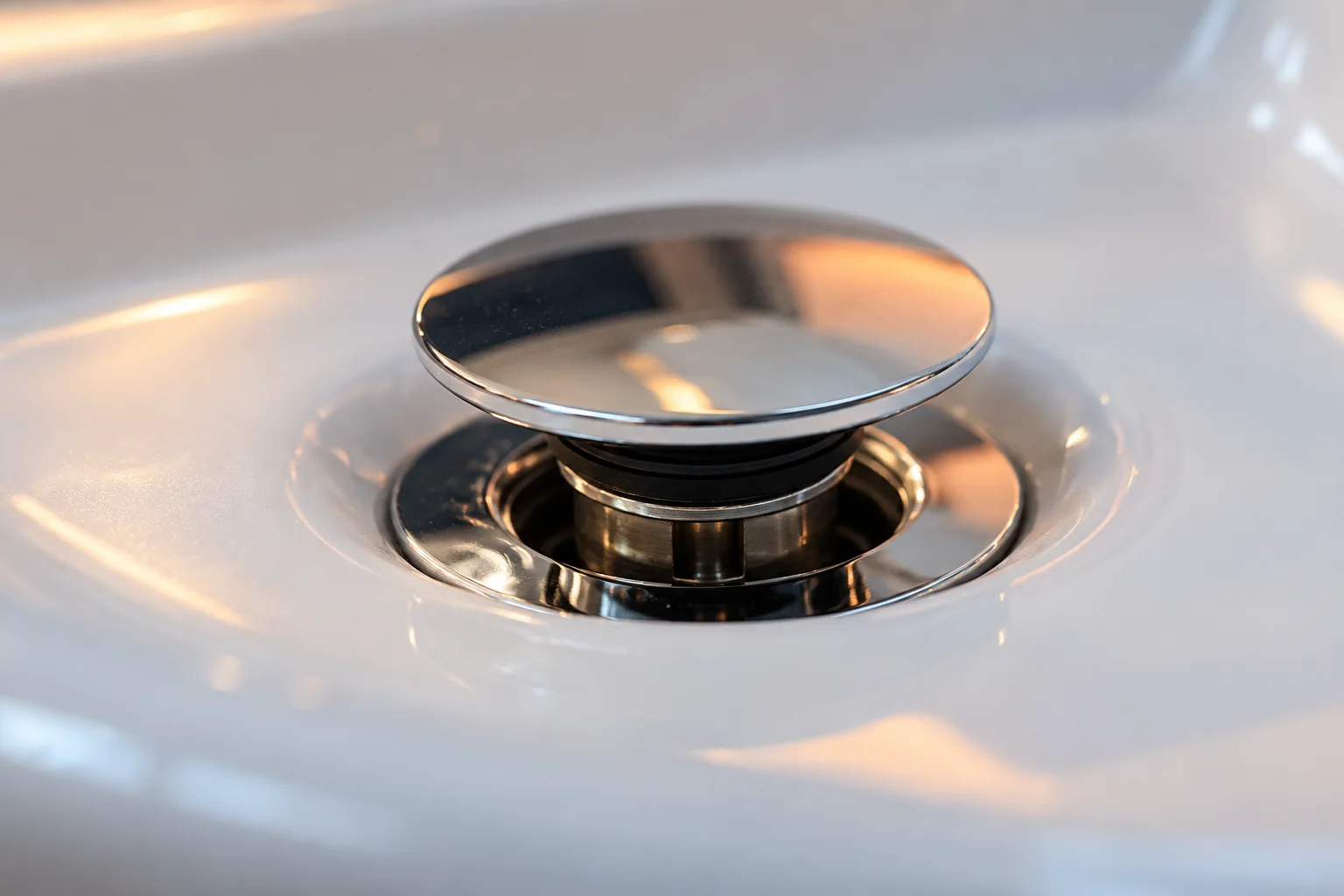
This is a lift-rod, pivot-ball basin drain with a captured stopper. Push-to-click stoppers use another mechanism. The drawing omits sink overflow passages and is not a disassembly guide.
Sources & further reading
Source access dates are listed below. Manufacturer descriptions and patents support the specific constructions described, not every product.
- INS1929F — Lavatory drain installation instructions ↗
Moen · Retrieved 2026-10-17 · Lift rod/strap/pivot rod/ball and captured stopper hole versus removable option.
Selected assembly, captured option9B. No installation dimensions reused. - Pop-up drain assembly not closing or opening properly ↗
Moen Solutions · Retrieved 2026-10-17 · Pull lift rod up to close; strap connection and adjustment affects stopper action.
Troubleshooting selected lift-rod drains; no universal stopper claim.