
Look a little closer
See the mechanism
Heating and cooling reverse buoyancy
Read the diagram
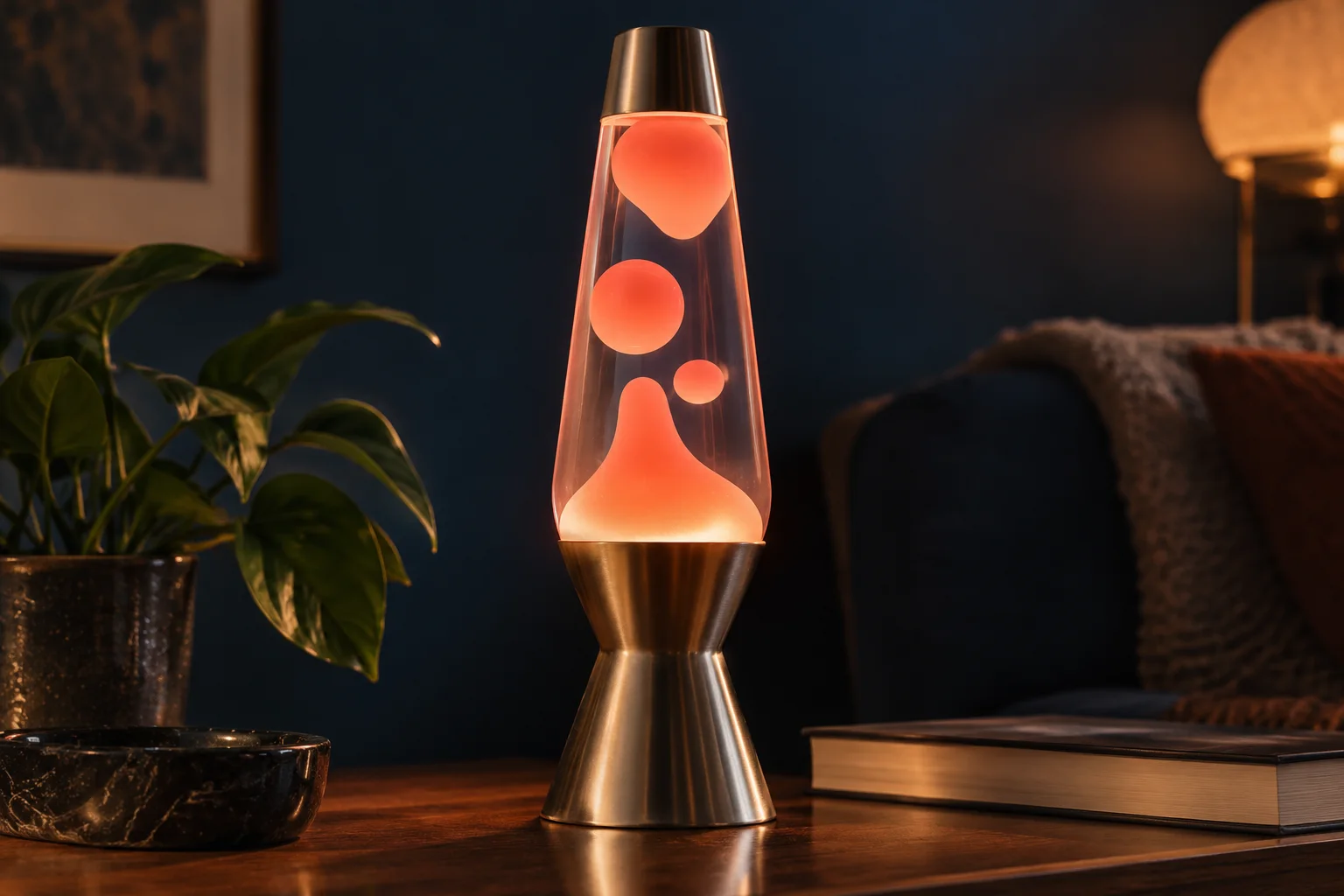
A density cycle in the bottle. Heat from the base warms the wax-rich material. Thermal expansion can make it less dense than the surrounding liquid, so it rises. Higher in the lamp it loses heat, becomes denser relative to the surrounding liquid and sinks. The cycle depends on both materials and operating temperature.
Qualitative wax/liquid density cycle. Blob shapes, sizes and paths are illustrative, not temperature or flow measurements. The diagram does not disclose a lamp recipe or an exact density crossover.
Diagram basis: LAVA: lamp science.
The blob changes volume, not its amount of wax
Density is mass divided by volume. When a portion of wax expands on heating, roughly the same mass occupies more space, so its density decreases. The important comparison is with the liquid around it: a blob rises when the upward buoyant force exceeds its weight.
The wax and surrounding liquid are formulated so that this comparison can reverse across the lamp's working temperatures. Wax that stayed denser at every temperature would remain below; wax that stayed less dense would remain above. The lamp needs the crossing between those conditions.
The base supplies heat and the surroundings remove it
The bulb beneath the bottle both illuminates the contents and supplies heat. Wax near that base warms, melts and expands. A rising blob carries warmer material away from the strongest heat source.
Farther up the bottle, the wax loses heat to its surroundings. It contracts and becomes denser relative to the liquid, then falls. Reaching the base brings it back to the heater. Electrical energy keeps entering the lamp and heat keeps leaving it; the movement is not a self-powered cycle.
The moving shapes are wax, not rising gas bubbles
The visible masses are a separate wax-rich material suspended in a liquid mixture. The lamp's motion comes from the heating and cooling of those masses. It does not depend on repeatedly making gas bubbles that lift colored liquid, as some tabletop demonstrations do.
Flow needs time to develop because the wax must warm through before it can move freely. The bulb and the room conditions affect that heat balance. Mathmos warns that the wrong bulb can prevent flow or overheat the bottle; adding brightness is not a substitute for the specified heat source.
The thing to remember
The wax's rise and fall track a changing density comparison, sustained by heat entering at the base and leaving through the lamp's surroundings.
What this example leaves out
Commercial formulas are proprietary. This explains the thermal wax cycle, not an exact recipe, startup time or gas-driven demonstration. Follow the lamp's own operating instructions and leave its sealed bottle closed.
Sources & further reading
Source access dates are listed below. Manufacturer descriptions and patents support the specific constructions described, not every product.
- Mathmos Lava lamps — Frequently Asked Questions ↗
Mathmos · Retrieved 2026-10-17 · Warm wax expands/rises, cooling/sinking; specific bulb/heat; sealed formulation.
Commercial thermal wax lamps; no proprietary recipe or therapeutic claims. - FAQ — How do LAVA lamps work? ↗
LAVA Lamp · Retrieved 2026-10-17 · Wax heated by base bulb, relative density reverses with heating/cooling and produces circulation.
Commercial sealed wax/liquid lamp; recipes excluded.