
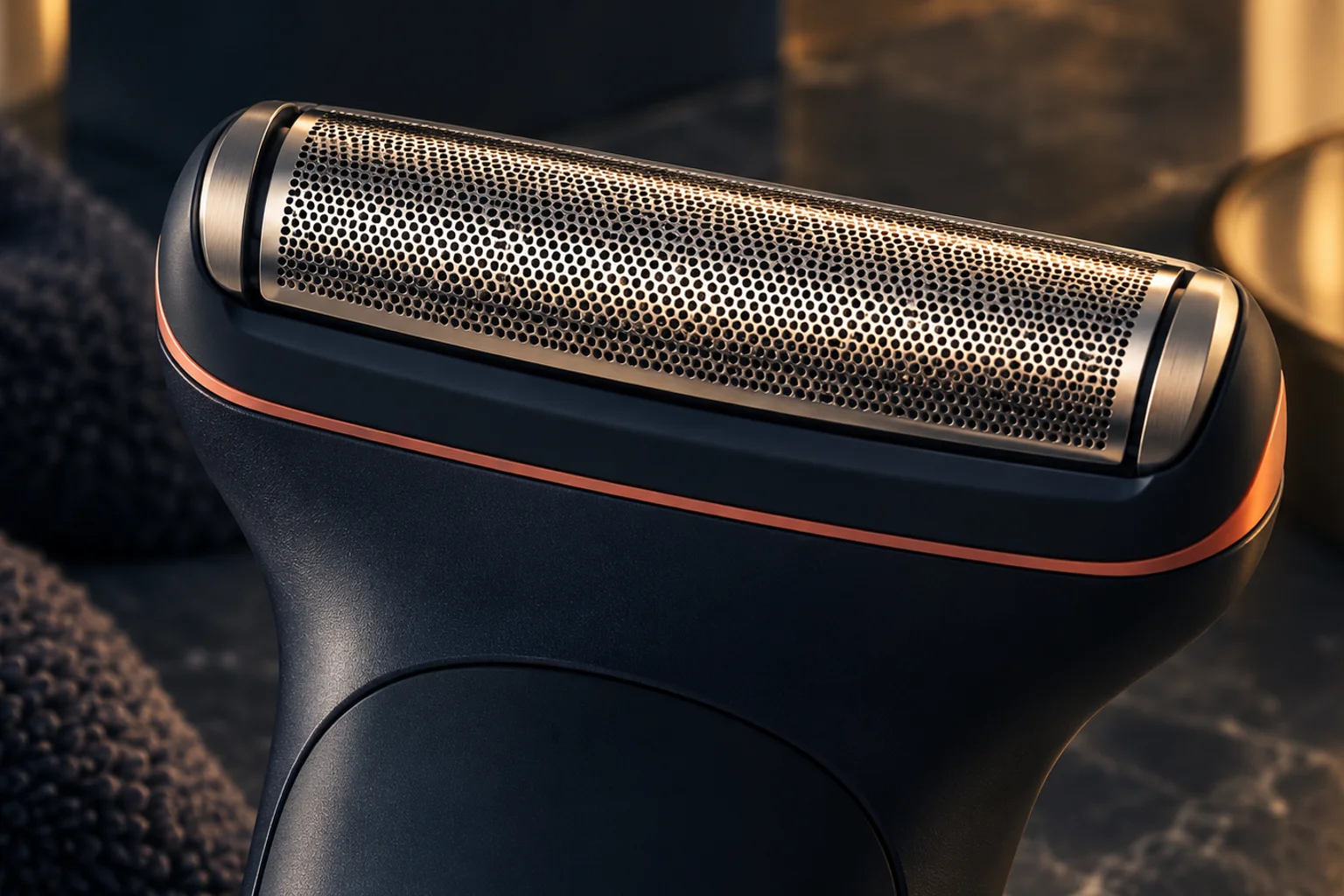
Look a little closer
See the mechanism
Reciprocating edges cut hairs inside foil openings
Read every step
- Hair enters an opening. Hair reaches through an opening in the perforated outer foil. The inner cutter lies immediately beneath the foil; it is not a decorative blade floating far below the openings.
- Cutter shears the hair. The inner cutter shifts sideways relative to the foil. The cooperating cutting edges shear the hair that entered the opening. The cutter reverses repeatedly; it does not rotate like a rotary-shaver head.
Original enlarged section of the foil-unit principle. Skin is shown separately above the foil, not as a protective guarantee. Clearance, hair and edge dimensions are qualitative. This omits the separate slit-cutter invention described elsewhere in the same patent.
Diagram basis: US20170312927A1: foil-type cutter units in Fig. 2 description.
Sources: Braun UK · Braun GmbH; United States patent publication via Google Patents
The screen and cutter work at the same opening
Braun describes its foil shavers as oscillating blades beneath a thin metallic layer. Hairs pass through the holes in that layer and meet the moving cutter below it. The motor-driven blade does not need to sit exposed on top of the skin to cut the projecting hair.
The hair must enter an opening before the moving edge can shear the portion projecting inside. Each opening gives hair a route to the cutting surfaces while the surrounding foil lies above the moving cutter.
Sources: Braun UK
Relative movement provides the shearing action
The outer foil stays with the shaving head while the inner cutter moves relative to it. That difference in movement is essential. Two parts moving together without an edge passing the hair would not produce the selected shearing action.
Braun's patent description of foil-type cutter units identifies an outer blade with openings and an inner blade driven to oscillate. It separately describes a slit cutter for other hair capture. A multi-element head can contain both, so its visible strips needn't all be identical foil units.
The foil separates the moving cutter from direct broad contact with skin, but its openings are necessary for the mechanism. At the cutting point, an entering hair meets the inner edge immediately beneath the foil. A gap that kept those cutting surfaces away from the hair would prevent their intended shearing contact.
Sources: Braun GmbH; United States patent publication via Google Patents · Braun UK
The thing to remember
The hair enters an opening and is sheared where the moving cutter meets the foil's underside. The two cutting parts need relative motion.
What this example leaves out
The enlarged cutaway selects a reciprocating foil unit and omits drive details. Foil patterns, moving-cutter geometry and extra trimmers vary. It is not an operating guide or a guarantee against skin injury.
Sources & further reading
Source access dates are listed below. Manufacturer descriptions and patents support the specific constructions described, not every product.
- Electric Shavers — How does an electric shaver work? ↗
Braun UK · Retrieved 2026-10-16 · Foil shaver has oscillating blades beneath perforated metal foil; entering hairs are cut by relative motion.
Actual About Braun FAQ paragraph253–257 read. Universal skin suitability, cuts/irritation promises, model speeds, waterproofness and technique advice excluded. - Blade, Shaver With A Blade And Method For Producing A Blade — US20170312927A1 ↗
Braun GmbH; United States patent publication via Google Patents · Retrieved 2026-10-16 · Detailed descriptionFIG2 identifies foil outer blade with hair openings and motor-driven oscillating inner blade; separate slit cutter.
Actual Detailed Description paragraphs273–276 read. Novel slit-cutter concave clearance geometry not applied to the foil mechanism. No source figure pixels or exact current-product internals claimed.