
Look a little closer
See the mechanism
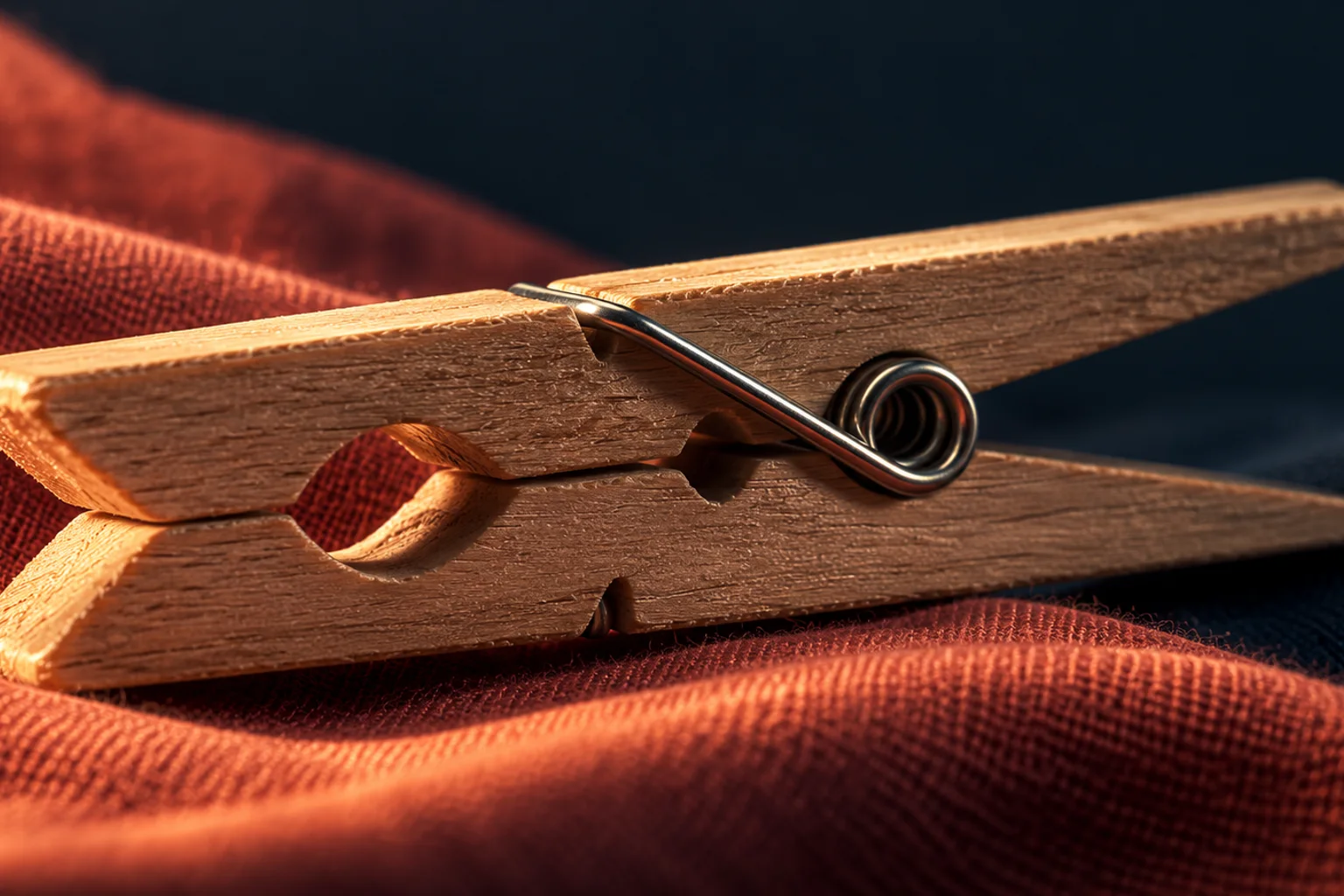
The spring returns two pivoting halves
Read every step
- Pinch the tails. Squeezing the tails brings them closer on one side of the common pivot. The jaw ends swing apart on the other side. The torsion spring deforms as its arms bear against the two halves.
- Release the tails. The loaded torsion spring pushes the halves back toward their gripping position. The tails spread as the jaw ends close onto the object between them. The spring and the body contacts support the return.
Original functional side view of a two-piece torsion-spring clothespin, not a particular wooden or molded product. Coil and arms are enlarged; special molded alignment hooks in the cited patent are omitted. Arrows show qualitative motion, not clamping force.
Diagram basis: US2748437A: pivot, coil, spring arms and opposing tails/jaws.
Sources: United States patent publication via Google Patents · Automated Industrial Motion
The handles move together while the jaws move apart
Each half runs from a handle, past the central pivot region, to a gripping jaw. Because the pivot lies between those ends, rotating a half takes its handle inward and its jaw outward. Two opposing halves turn a small pinch into an opening at the mouth.
The middle spring doesn't merely sit nearby. In the documented spring-clothespin arrangement, its coiled region lies between the halves and its projecting ends bear on them. Those contacts couple the spring's tendency to return with the movement of the two levers.
The patent example also adds molded guides that keep the halves aligned. Those guides are a particular construction detail, separate from the opening-and-return action shared by this spring type.
Sources: United States patent publication via Google Patents · Automated Industrial Motion
Letting go releases the stored movement
A torsion spring resists a change in the angle between its ends. Opening the pin moves those ends relative to each other. Release the handles and the spring applies a turning force in the closing direction. No latch has to drop into place for that return to happen.
If fabric and a line stop the jaws meeting completely, the spring still urges them inward. The clothespin remains partly open around the material and continues to press on it. That is the loaded state, even though your fingers are no longer supplying the squeeze.
Sources: Automated Industrial Motion · United States patent publication via Google Patents
The thing to remember
Your pinch opens two pivoting levers against a spring. Releasing the pinch lets that spring press the jaws closed.
What this example leaves out
The figure selects a two-piece torsion-spring clothespin and simplifies its bearings. Wood, molded plastic and one-piece pegs differ. Jaw shape and grip force are product-specific.
Sources & further reading
Source access dates are listed below. Manufacturer descriptions and patents support the specific constructions described, not every product.
- Clothespin — US2748437A ↗
United States patent publication via Google Patents · Retrieved 2026-10-16 · Opposing handle/jaw members rotate about middle; coil and spring ends bias jaws together; squeezing handles spreads jaws.
Description and claims1–3 read. Molded rib/groove guides are specific to patent, not universal wooden-clothespin details. - All About Torsion Springs ↗
Automated Industrial Motion · Retrieved 2026-10-16 · Torsion spring ends attach to adjacent parts; angular loading and return; clothespin example connecting two wooden clamps.
Web fetch timed out; live page fetched directly with Node, script/style removed, actual How Torsion Springs Work passage read. No spring-rate calculation, mandrel requirement or exact product geometry generalized.