Look a little closer
See the mechanism
The cap supplies the support point
Read the diagram
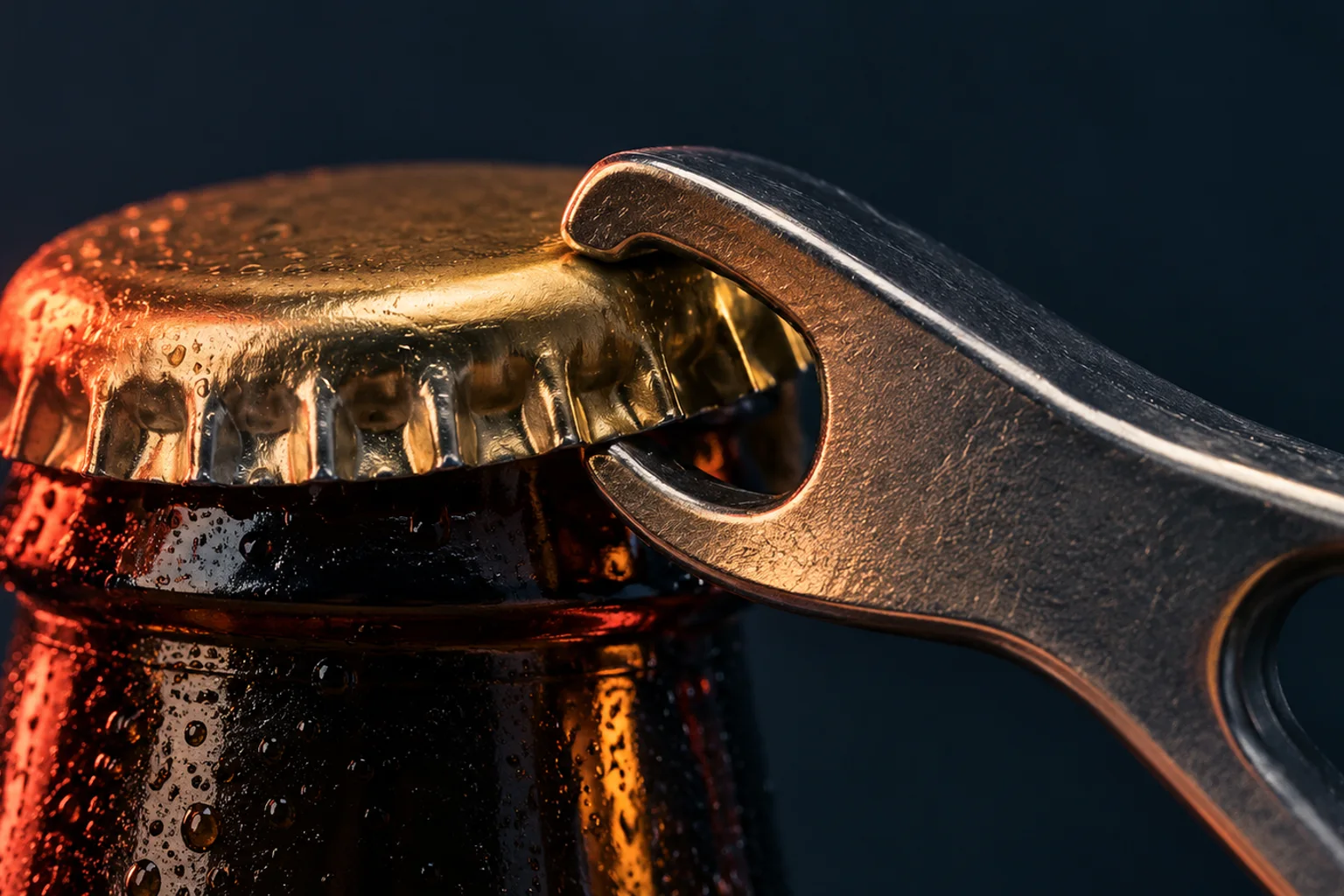
The hook takes hold beneath the crown cap’s crimped edge. A second contact rests on the top of the cap. Rocking the handle about that contact lifts and spreads the gripped edge so it can clear the bead on the bottle neck.
Original contact model, not to scale. The bent crown flange and neck bead are enlarged. Arrows show qualitative lift, not force or required leverage. The support bears on the cap; this drawing does not prescribe levering against glass. Tool silhouettes differ.
Diagram basis: US2533818A: hook, cap-bearing fulcrum and handheld variant, Fig. 8 discussion.
Sources: Franz K. Krag; US patent publication via Google Patents
The cap reaches beneath a bead of glass
A crown cap isn't held on merely by resting tightly on the bottle's mouth. Its folded skirt extends down around a raised bead at the top of the neck. Crimping shapes that skirt around the bead, leaving metal that catches beneath it.
Pulling straight up must overcome that engagement. An opener instead concentrates its action on a small part of the skirt. Its hook enters the narrow clearance under the metal edge, so a turning motion can begin freeing one part before the whole cap comes away.
Sources: Franz K. Krag; US patent publication via Google Patents
The handle turns around a second contact
The hook lifts beneath the skirt while another part of the tool bears on the cap. In the handheld version described in patent US2533818A, the tool rocks about that raised bearing point. The handle places the hand farther from these small working contacts, giving its movement leverage.
As the tool turns, the hook and bearing point apply different forces to the cap. The edge lifts and moves outward enough to clear the bead. The cap bends during removal; the opener doesn't need to unscrew it or cut a new opening through the middle.
Sources: Franz K. Krag; US patent publication via Google Patents
A wall opener holds the tool still
A wall-mounted opener can keep those working contacts in place while the bottle is moved. A handheld opener lets the tool move while the bottle is held. The visible motion changes, but the central task remains to deform and disengage the crimped metal edge.
The selected patent describes both arrangements and places its bearing action on the cap. The hook and bearing point work together on the metal: one catches beneath its edge while the other supports the tool's turning movement. Other cap-removal designs can place those contacts differently.
Sources: Franz K. Krag; US patent publication via Google Patents
The thing to remember
The opener releases a mechanical catch: it holds beneath the cap's skirt and pivots against another part of the cap to bend that catch clear.
What this example leaves out
The explanation concerns pry-off crown caps and the two-contact mechanism documented in US2533818A, including its handheld version. Screw caps, damaged bottles and exact force requirements aren't covered.
Sources & further reading
Source access dates are listed below. Manufacturer descriptions and patents support the specific constructions described, not every product.
- US2533818A — Fulcrum type bottle opener ↗
Franz K. Krag; US patent publication via Google Patents · Retrieved 2026-10-16 · Crown flange crimped beneath neck bead; hook/fulcrum contacts deform flange; both wall-mounted and handheld versions, including rocking about point18.
Description of crown flange and hook13/point18 read; Fig8 handheld-version discussion explicitly read, web lines125–127 and207–208. Original schematic must retain cap-bearing contact. This is a design example, not a universal tool geometry or proof of present-day adoption.